
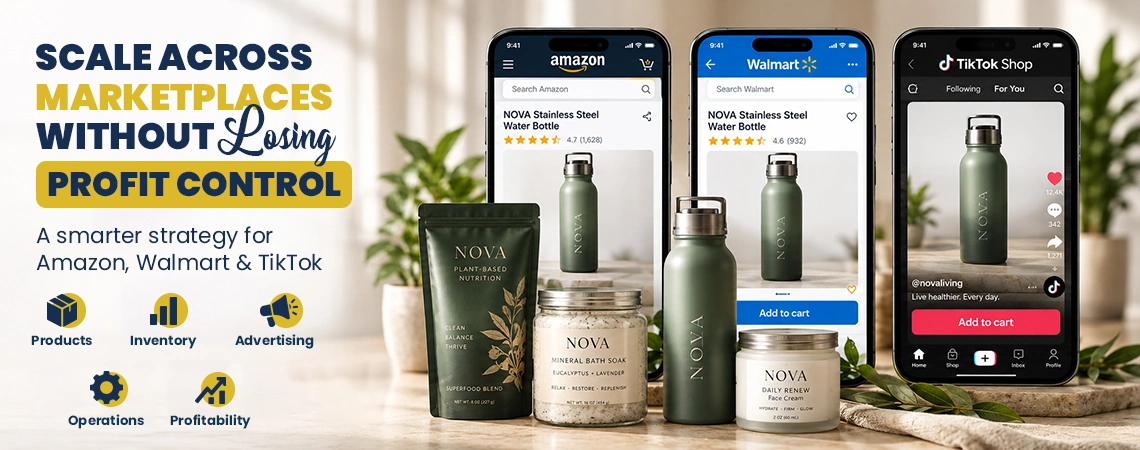
Marketplace Expansion Strategy: How High-Growth Brands Scale Amazon, Walmart & TikTok Without Losing Profit Control
Growth is no longer about whether a brand should expand across marketplaces, it's about how to do it without losing control of profitability.
A Shopify brand starts gaining traction, someone suggests Amazon, and suddenly, the business is running across multiple platforms with no real system holding it together. One person manages ads, another handles listings, someone else designs creatives, and fulfillment sits completely outside the loop. Revenue increases, but profit doesn't follow the same curve. Worse, nobody can clearly explain what is actually driving performance.
This is the exact problem that Saad Sohail Khan, founder of SpectrumBPO, has spent nearly two decades solving. Instead of building another fragmented agency model, he created an integrated execution system designed to make marketplace expansion predictable, measurable, and profitable.
 Why Most Marketplace Expansion Strategies Break Down
A common mistake in ecommerce is when sellers think that expanding to more platforms will lead to growth. In reality, this is the multi-marketplace trap stalling ecommerce brand growth. Adding marketplaces like Amazon, Walmart, or TikTok Shop without a system creates more problems than progress.
The pattern looks like this:
- A brand hires a freelance PPC specialist
- A separate listing expert handles content
- A designer works only on creatives
- A third-party agency manages fulfillment or logistics
Each part may be done well on its own, but they're not connected into a system. There's no strategy between ads, product pages, sales performance, and inventory.
Because of that disconnect, money gets lost without anyone clearly seeing where it's happening. So the business ends up looking active and productive, but it's not actually running efficiently or improving overall.
The Real Problem Isn't Traffic, It's Execution Clarity
Most brands think the growth challenge is traffic. But for many sellers, the toughest part of running an e-commerce store is maintaining operational clarity as listings, ads, inventory, and fulfillment expand across multiple marketplaces. Most ecommerce stores already have traffic. The issue is what happens after the click.
Brands don't have a traffic problem; they have an execution problem.
Execution includes:
- Listing quality and structure
- Conversion rate optimization
- Keyword coverage across marketplaces
- Pricing alignment
- Inventory accuracy
- Advertising efficiency
When these elements are disconnected, high traffic doesn't convert into profit. This is why two brands with the same revenue can have different margins. One is optimized as a system. The other is operating as a collection of tasks.
Why Integrated Teams Outperform Fragmented Freelance Models
SpectrumBPO was built around one principle: ecommerce should operate like a unified system, not a set of outsourced tasks.
Today, we operate with over 400 in-house specialists who manage 500+ active brands across Amazon, Walmart, eBay, TikTok Shop, and Etsy.
The difference isn't size. Its structure.
Instead of isolating roles, teams are trained to operate inside a shared system where:
- PPC decisions are tied to listing performance
- Content strategy aligns with keyword data
- Creative design supports conversion goals
- Inventory signals feed into advertising decisions
This eliminates one of the biggest inefficiencies in ecommerce: delayed feedback loops.
When everything is connected, decisions become faster and accurate.
Why Not Every Brand Is Ready for Multichannel Expansion
One of the controversial principles in our approach is the threshold requirement of the revenue. SpectrumBPO does not onboard brands below roughly $40K-$50K in monthly revenue. It's an operational reality.
At lower revenue levels, brands struggle with:
- Unclear product-market fit
- Inventory flow
- Listing foundations
- Limited data for optimization
The goal is not to reject new brands. It's to ensure that optimization efforts are applied where they can compound.
Cutting Ad Waste Before Scaling Spend
One consistent pattern in ecommerce is that sellers overspend on advertising before they fix the issue of the conversion system. This is one of the first issues a professional Amazon agency identifies during account audits. During audits, we have seen that most Amazon accounts have 20% to 30% of ad spend wasted
This waste is from:
- Keywords that are non-converting but still receive budget
- Campaigns are not structured
- Weak listing conversion rates
- Targeting of irrelevant search terms
Many sellers ignore the insight that increasing ad spend does not fix a broken conversion system.
The correct sequence is:
- Fix listings and content
- Improve conversion rate
- Optimize keyword coverage
- Then scale ads
When brands reverse this order, their margins shrink, and revenue grows.
The Hidden Profit Engine Most Brands Ignore: FBA Reimbursements
With advertising and sales growth, there is a reconciliation profit layer that many brands overlook.
Within Amazon systems, brands lose money through:
- Missing inventory units
- Damaged goods not properly recorded
- Overcharged fulfillment fees
- Shipment discrepancies
These issues can add up to thousands of dollars per month.
The important shift in mindset is this:
Reconciliation is a recurring profit stream. Brands that invest in Amazon reconciliation services to audit and recover these losses discover they have been leaving unclaimed money on the table for months or even years.
Why No Single "Amazon Expert" Can Scale a Multichannel Business
When sellers plan to hire someone, they think that one person can be an expert in everything. But, multichannel growth requires different skill sets:
- PPC strategy is analytical
- Listing optimization requires keyword and conversion expertise
- Creative design influences the CTR of brand perception
- Catalog management impacts discoverability and indexing
- Pricing strategy affects ranking and profitability
Expecting one person to manage all of this across Amazon, Walmart, and TikTok Shop is unrealistic. This is why structured teams outperform individual specialists in complex environments.
Agency vs In-House Execution: The Alignment Problem
SpectrumBPO takes a performance-first approach built around accountability and results. Instead of locking clients into long-term fixed contracts, we begin with a 30-day free management period, during which we manage your e-commerce accounts and drive performance improvements.
After the trial period, continuation is based on results. If the improvements are measurable, you can choose to move forward with an affordable, flexible pricing structure. We also operate on a mutually agreed revenue-share model, ensuring compensation is directly tied to success.
Case Insight: What Changes When Execution Becomes Systemized
If a mid-size ecommerce brand is doing around $60K-$120K per month.
Before optimization, issues include:
- Inconsistent ad performance
- Profitability per SKU is not clear
- They had weak listing conversion rates
- Channel management was fragmented
After the implementation of a structured system:
- Their wasted ad spend reduces
- Optimized listings drive conversion
- Reconciliation identifies hidden recoveries
- Channel ownership becomes defined
The outcome is healthier margins and predictable scaling.
AI Is Changing Ecommerce Discovery Faster Than Most Brands Expect
A major shift happening right now is how products are discovered online. E-commerce platforms have enabled AI-driven storefront discovery. Amazon has introduced an AI layer through Rufus, but it operates within a closed ecosystem.
For brands, this changes the rules of visibility.
Search is no longer just about keywords. It's about structured product data, content clarity, and authority signals that AI systems can interpret.
Brands that ignore AI in e-commerce risk becoming invisible in the next phase of discovery.
How to Prepare for AI-Driven Ecommerce Discovery
To stay competitive in this new environment, brands need to focus on:
- clean, structured product data
- consistent product descriptions across platforms
- strong on-site content that reinforces product relevance
- accurate categorization and metadata
- conversion-focused landing pages
AI systems prioritize clarity and consistency. Brands with messy or fragmented data are less likely to surface in recommendations.
Final Takeaway: Growth Without Systems Is Just Noise
Ecommerce growth is misunderstood as a revenue problem. When marketplaces, ads, listings, inventory, and analytics operate in silos, growth becomes unpredictable. But when those systems are unified through full Amazon account management and connected operational strategies, scaling becomes repeatable.
The real advantage in modern ecommerce is no longer access to platforms. It is the ability to connect them into a coherent operating system. That is what separates brands that grow from brands that sustain growth.
Share this Post




Blog Categories
Uncategorized
