

How to Scale my eCommerce Business
One of the most important first moves in the direction of long-term success is scaling an internet retail enterprise. Understanding how to scale my ecommerce business, the equilibrium between supply and demand is essential whether you are a novice seller getting into the market or a current seller trying to grow your business.
 Essence of Scaling Your eCommerce Business
How to scale my ecommerce business means efficiently increasing revenue and sales while maintaining operational effectiveness. It involves expanding product offerings, optimizing supply chain management, and meeting customer demand. Whether you are a new seller or an established one, scaling requires a well-planned strategy to ensure profitability and sustainability.
Let's briefly look at some strategies that help you boost your ecommerce business:
- Optimize Product Listings for Maximum Visibility
- Expand to Multi-Channel Selling
- Utilize Data-Driven Marketing to Sell Smarter
- Boost Customer Retention for Long-Term Growth
- Streamline Operations for Better Efficiency
- Strengthen Brand Identity & Build Social Proof
- Expand Product Line to Increase Revenue
- Optimize Pricing Strategies for Competitive Edge
- Improve Fulfillment & Logistics for Faster Delivery
- Track & Improve Performance for Continuous Growth
Tools And Platforms to Grow Your E-Commerce Business
For how to scale my ecommerce business, you need knowledge, expertise, and tools to pull it off. The best way to learn comes from consulting experts for starting an ecommerce. They help you analyze and identify the need for scaling for you. You can always hire an ecommerce growth agency to scale your ecommerce business. Choose platforms like SpectrumBPO that provide specialized e-commerce solutions tailored to your business, guaranteeing the scalability process is smooth and efficient. Hire an ecommerce growth agency or reaching out with the necessary specialized help can make the difference if you seek guidance specific to your situation.
For how to scale my ecommerce business, you need knowledge, expertise, and tools to pull it off. The best way to learn comes from consulting experts for starting an ecommerce. They help you analyze and identify the need for scaling for you. You can always hire an ecommerce growth agency to scale your ecommerce business.
How to scale my ecommerce business as a New Seller
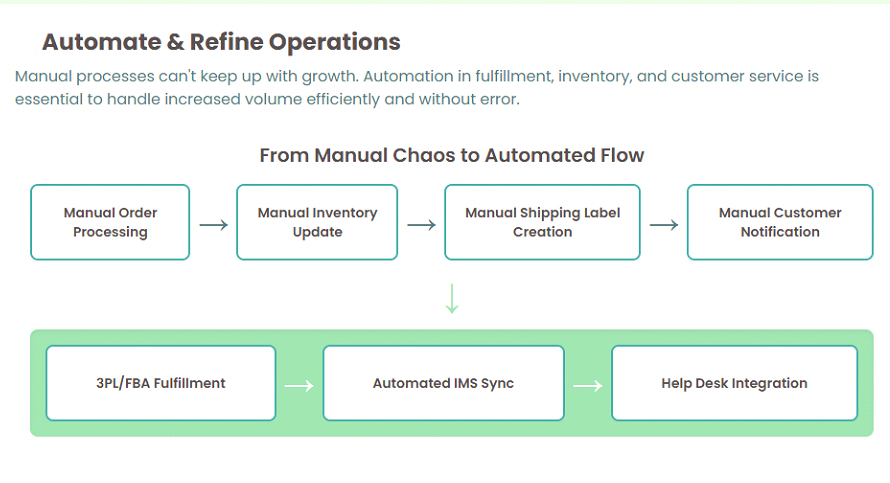
To gain a competitive edge and establish a strong market presence.
In eCommerce, a fledgling merchant enters a dog-eat-dog market where thousands of goods go live daily. Without scaling, their product could be drowned by well-known businesses. New sellers can create a strong presence in the market by maximizing listings and broadening reach, drawing customers, and carving out a particular niche in the market.
To increase revenue and profitability.
While sales volume growth has a direct effect on revenue, profitability is the factor deciding future success. A New seller always asks this question from SpectrumBPO: How Long Does It Take To Make Money With eCommerce without losing money? Our small answer is that by scaling, sellers can fine-tune their pricing, increase their product variety, and use marketing campaigns to spur sales. The more effectively they scale, the more possibilities arise to optimize revenue while still keeping cost-effectiveness.
To leverage economies of scale and reduce costs.
More orders mean more supplier offers, reduced shipping charges, and operational efficiency. A seller processing several orders daily will always have more per-unit costs than one who handles hundreds. Smart scaling permits them to find better rates and better margins, which in turn makes their enterprise more viable.
Ability to reach a larger customer base.
A seller without scaling attracts only a small audience, therefore lowering sales opportunities. Increasing visibility includes working on Amazon SEO services, running paid promotions, and spreading across several channels. The larger the audience, the more probable the company will organically expand and draw repeat consumers.
Potential to build a strong brand identity.
A brand identity is the confidence and recognition a seller develops over time; it is not simply a logo. Scaling lets firms perfect their messaging, customer support, and packaging or display. A recognized brand sets itself apart, therefore boosting word-of-mouth advertising and customer retention.
Higher chances of achieving long-term sustainability.
While selling a few goods might result in short-term profits, real commercial stability depends on steady expansion. Scaling allows a company to operate under seasonal demand shifts, competition, and market vagaries. Without evolution, sellers risk stagnation or obsolescence.
Initial investment requirements may be high.
Growth is not free; fulfillment costs, inventory, and advertisement all accumulate. Many sellers do not realize how much money is needed to expand properly, therefore causing cash flow problems. They might grow too quickly and find maintaining operations difficult in the absence of careful financial preparation.
Risk of mismanaging inventory and supply chain.
Too little stock results in missed sales chances, whereas too much leads to storage expenses and possible losses. To circumvent these issues, scaling calls for accurate demand estimation and dependable suppliers. Many new merchants run out of stock or miss deadlines, therefore lowering customer confidence.
Tough competition from established sellers.
Competition with well-known labels demands twice the effort by new sellers to be noticed. Established companies have perfected systems, and customer confidence is already there. Standing out depends on wise scaling together with competitive pricing, effective branding, and outstanding customer service.
Increased revenue potential.
A growing business means more customers, higher sales, and the ability to expand into new markets. Each extra purchase helps to boost the bottom line, so long-term success depends on expansion. Without scaling, a seller remains stuck in a cycle of small profits and limited reach.
Greater market share.
Although it takes time to enter a niche and become its master, scaling accelerates the process. A seller's growth makes it more difficult for rivals to replace them. Building on an early market share provides a solid basis for later expansion.
Enhanced customer trust and brand recognition.
A company with consistent availability and great reviews is more probably chosen. Scaling helps vendors to establish credibility, refine branding, and enhance their service. Good results will come from repeat trade and natural references.
Having a deep understanding of Practical E-commerce Marketing Strategies That Help Brands Increase Sales Across Amazon, Shopify, Walmart & More is important for both new and existing sellers. This is where expert teams jump in and work with sellers for visibility, lower ad costs, and revenue growth.
How to scale my ecommerce business as an Existing Seller
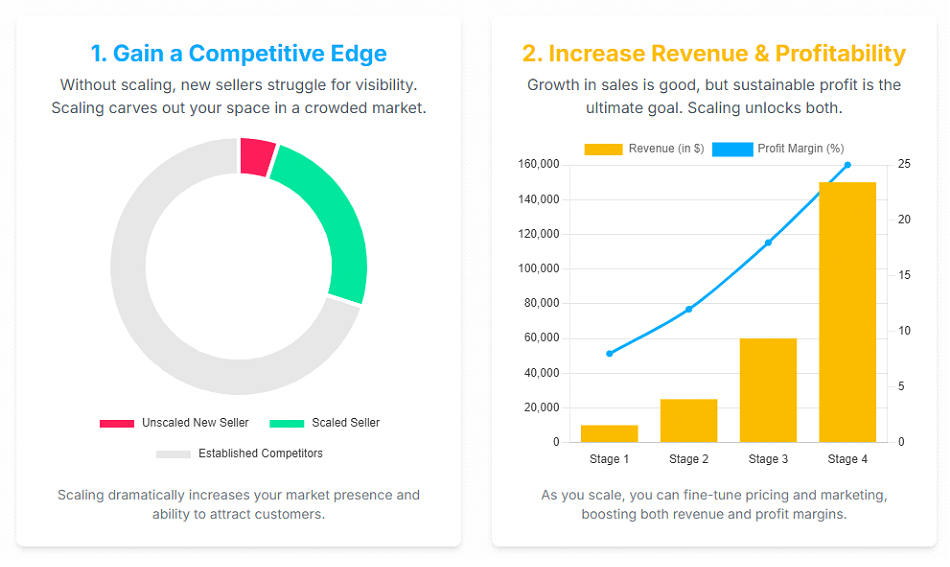
To sustain market position and outpace competitors.
In ecommerce, to sit still is to fall behind. Rivals are always improving marketing campaigns, releasing fresh products, and launching innovation. By scaling, an existing seller stays ahead, conforms to trends, and remains a dominant player in their field.
To increase profitability and operational efficiency.
Growing is not only about more sales; it is also about streamlining processes. Scaling helps vendors to negotiate volume discounts, streamline operations, and enhance fulfillment plans. An effective business lowers unneeded costs and raises revenue.
To expand into new product categories and markets.
Growth becomes the obvious next move after a seller has built a strong customer base. Diversification of revenue streams comes from going after foreign markets or introducing new lines of products. A seller restricted to one field of goods will become stagnant as other companies expand.
Easier access to resources and market insights.
Experienced sellers already possess operational knowledge, supplier contacts, and customer data, which new sellers lack. This knowledge helps to reduce the volatility and increase the predictability of scaling. An established base grants them a head start to grow.
Established brand credibility.
A recognized brand will find it easier to start fresh goods, negotiate contracts, and boost sales. Someone who has already bought from a seller is more likely to have trust in life. Brand authority helps to lower procurement prices and increase long-term sustainability.
Better understanding of customer preferences.
Past sales numbers offer important information about consumer behavior. This will help existing sellers to perfect their marketing, prices, and inventory management. Knowing what works lets them scale effectively and with lifted risk.
Increased operational complexities.
Running a company entails handling more customer requests, more orders, and more products. Operations can spiral out of control if there are no organized systems present. Increased demand calls for sellers to spend on automation and organized processes.
Higher fulfillment and logistics costs.
Storage, transportation, and supply chain costs increase with the volume of orders. Without meticulous cost control, more sales sometimes do not lead to more earnings. It is absolutely critical to strike the right level of expansion and performance.
Need for continuous innovation and adaptation.
What works today may not work tomorrow. Consumer desires, market developments, and platform algorithms all shift often. To keep their competitive advantage, good sales must continuously invent and adjust.
Strengthened brand authority.
A rising company acquires customers and improves recognition, setting dominance in their sector. Scaling improves brand recognition, that makes it more difficult for the competition to surpass you.
Diversified revenue streams.
Depending on one thing or one industry is dangerous. By scaling, sellers can enter new markets and launch fresh products, lowering reliance on one source of revenue. Diversification helps to maintain financial resilience.
Increased customer loyalty and repeat sales.
Trust builds more when a brand grows more. Strong names promote repeat buys and long customer partnerships. By scaling, a company stays pertinent and keeps drawing repeat customers.
10 Smart ways to scale your business effectively
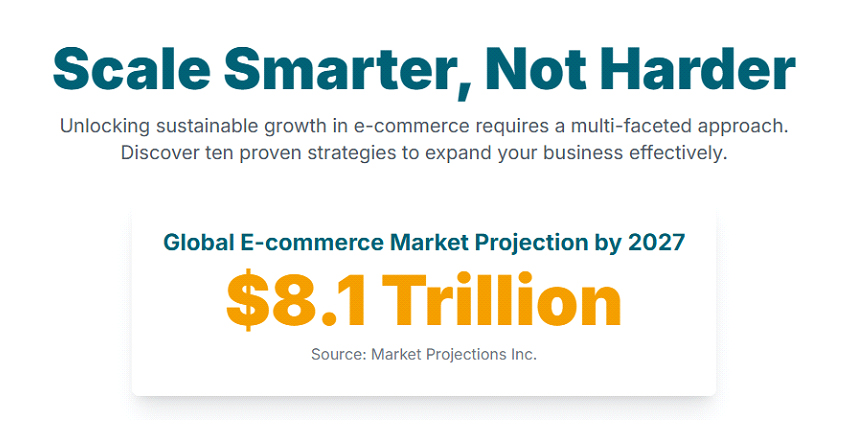
Scaling your e-commerce business ideally would entail a mix of strategic guidelines, concentrated operations, and effects of successful marketing. The following foundations give you a footing to start scaling effectively.
- Optimize Product Listings for Maximum Visibility
When people look for a product online, seventy out of 100 never go beyond the first page. Amazon listing optimization services are really important, and If your product isn't visible, sales will be difficult. Customers will keep moving your product listing if the title is vague, the photos are of poor quality, or the description is unclear; it serves as your digital sales rep.
New sellers should give attention to writing obvious, keyword-rich product titles, clear, high-resolution photographs, and simple-to-read descriptions. Experienced sellers would do well to constantly test various headlines, descriptions, and photos to determine what draws more people. Little improvements, such as more thorough product titles, can greatly rise the rate of click-through.
- Expand to Multi-Channel Selling
Before getting bigger, fresh sellers should first be experts on one platform. Experienced sellers must vary their listing by advertising products on many marketplaces and investigating global markets, including Amazon UK or Canada. Expanding beyond one platform has enabled a lot of companies to grow their sales.
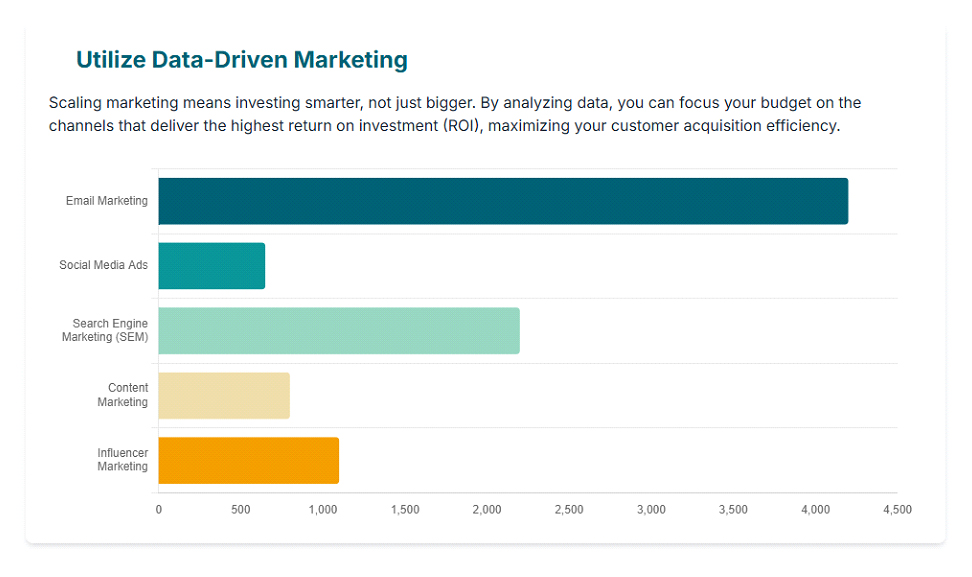
- Utilize Data-Driven Marketing to Sell Smarter
Rookies should track where items are dropped off in the buying process, product views, and store traffic. Experienced sellers should go deeper-analyzing customer habits, testing different ad strategies, and refining their marketing using real data. The best companies draw on data to customize their marketing and suggestions to boost sales.
- Boost Customer Retention for Long-Term Growth
Thank you notes and slight discounts on repeat buys help new vendors to construct loyalty. Loyalty programs, subscription models, and special VIP benefits would benefit experienced vendors. Companies concentrating on keeping customers rather than just getting new ones establish a constant revenue stream and long-term brand loyalty.
- Streamline Operations for Better Efficiency
Handling all of them manually rather than streamlining their processes costs fifty percent of the firm's money. Efficient handling of inventory, customer service, sales, and distribution can provide room for growth with free time.
New vendors should have an organized inventory of customer contacts and products, set definite goals, and create a structured workflow. Inserting AI in ecommerce platforms can help automate routine tasks like demand forecasting, inventory tracking, and customer service responses, freeing up time for high-impact decisions. Seasoned sellers will focus on scaling their company by refining shipping methods, bettering vendor contacts, and assigning less important chores. Businesses with well-run operations are able to satisfy consumer needs without any superfluous delay. Stop burning your budget and get help from SpectrumBPO for your e-commerce growth expert support can dramatically reduce operational waste and accelerate your scaling efforts.
- Strengthen Brand Identity & Build Social Proof
Follow-up emails and modest rewards help new sellers entice critics. Experienced sellers should go further by highlighting consumer testimonials in marketing efforts, working with influencers, and drawing user-generated content on social media. Creating a strong brand image via customer faith results in more repeat purchases as well as better conversion rates.
- Expand Product Line to Increase Revenue
First, experienced sellers would want to see their initial product to be strong before they can grow. Experienced sellers should introduce complementary products that enhance their existing lineup. Successful companies create systems under which products interact, therefore simplifying consumer buying of several rather than only one.
- Optimize Pricing Strategies for Competitive Edge
New sellers need to investigate rivals and keep competitive pricing. Experienced salespeople might try several tactics, including product bundling, limited-time discounts, and free shipping, to help increase conversions. The correct balance of prices can have a major effect on customer satisfaction and sales volume.
- Improve Fulfillment & Logistics for Faster Delivery
New sellers might want to consider a reputable third-party delivery provider or Amazon FBA as their chosen fulfillment partner. Experienced vendors should negotiate better shipping rates, manage inventory strategically, and maximize warehouse sites, therefore lowering expenses and enhancing effectiveness. Customers who get their merchandise fast are more prone to delete and wish others to use the brand.
- Track & Improve Performance for Continuous Growth
First-time sellers should monitor top-selling items, customer engagement rates, and bounce rates. Experienced sellers would maximize their sales funnel by monitoring conversion rates, using thorough sales data, and running customer feedback surveys. The top companies apply knowledge to perfect their strategy and constantly increase performance over time.
 Challenges Faced by Existing Sellers During Scaling
- Managing high order volumes efficiently.
Greater sales make order fulfillment more complicated. Not having organized systems can result in customer complaints, slow processing, or mishandled deliveries. Scaling needs third party logistics (3PL) solutions or automation investment to properly manage great numbers.
- Maintaining profit margins with rising costs.
Scaled costs can come from advertising, fulfillment fees, and operating costs, as well as from marketing. In order to experience organic growth, sellers have to be constantly optimizing pricing structures, reducing unnecessary costs, and increasing efficiency.
- Expanding product offerings while maintaining quality.
Quality control can be challenging, even if there is a popular scaling strategy of diversification into new areas. Maintaining customer trust in multiple brand products, where you want to engage in a supplier partnership, requires testing with the suppliers, trustworthy brand positioning, and staging.
- Handling increased customer service demands.
Growth means more revenue, more complaints, and more questions. Negative ratings may harm brand image if an organization lacks a purposeful customer service approach, but established support teams and artificial intelligence chatbots assure customers a seamless experience.
Solutions for Existing Sellers During Scaling
- Implement tools for inventory and order management.
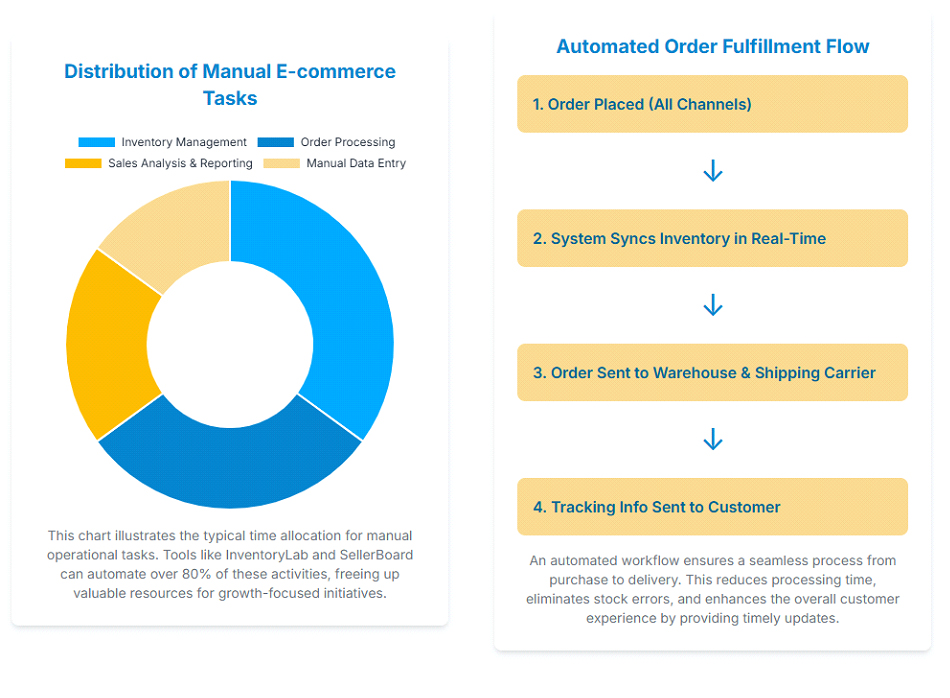
Inventory tracking, order processing and sales analysis can be leveraged by using a tool such as InventoryLab, Helium 10 or SellerBoard. This allows for more efficient handling of volume orders while reducing human error.
- Optimize pricing strategies and negotiate better supplier rates.
Data driven pricing strategies such as dynamic pricing, or competitor-based adjustments can optimize profit margins. Buying in bulk and negotiating long-term agreements with suppliers also reduce overhead costs and increase profits.
- Conduct market research before launching new products.
Aggressive growth without insight into market demand can be costly. Prior to investing in new stocks, there are ways to leverage Jungle Scout, AMZScout or consumer surveys to identify consumable products and customer tastes.
- Enhance customer support with dedicated teams.
A quick and responsive customer service team raises customer satisfaction and increases customer retention. Utilization of automated responses, FAQ pages (frequently asked questions), plus multi-channel responses (e.g., email, chat, social media) should all help resolve consumer issues.
Challenges Faced by Existing Sellers During Scaling
- Managing high order volumes efficiently.
Greater sales make order fulfillment more complicated. Not having organized systems can result in customer complaints, slow processing, or mishandled deliveries. Scaling needs third party logistics (3PL) solutions or automation investment to properly manage great numbers.
- Maintaining profit margins with rising costs.
Scaled costs can come from advertising, fulfillment fees, and operating costs, as well as from marketing. In order to experience organic growth, sellers have to be constantly optimizing pricing structures, reducing unnecessary costs, and increasing efficiency.
- Expanding product offerings while maintaining quality.
Quality control can be challenging, even if there is a popular scaling strategy of diversification into new areas. Maintaining customer trust in multiple brand products, where you want to engage in a supplier partnership, requires testing with the suppliers, trustworthy brand positioning, and staging.
- Handling increased customer service demands.
Growth means more revenue, more complaints, and more questions. Negative ratings may harm brand image if an organization lacks a purposeful customer service approach, but established support teams and artificial intelligence chatbots assure customers a seamless experience.
Solutions for Existing Sellers During Scaling
- Implement tools for inventory and order management.
Inventory tracking, order processing and sales analysis can be leveraged by using a tool such as InventoryLab, Helium 10 or SellerBoard. This allows for more efficient handling of volume orders while reducing human error.
- Optimize pricing strategies and negotiate better supplier rates.
Data driven pricing strategies such as dynamic pricing, or competitor-based adjustments can optimize profit margins. Buying in bulk and negotiating long-term agreements with suppliers also reduce overhead costs and increase profits.
- Conduct market research before launching new products.
Aggressive growth without insight into market demand can be costly. Prior to investing in new stocks, there are ways to leverage Jungle Scout, AMZScout or consumer surveys to identify consumable products and customer tastes.
- Enhance customer support with dedicated teams.
A quick and responsive customer service team raises customer satisfaction and increases customer retention. Utilization of automated responses, FAQ pages (frequently asked questions), plus multi-channel responses (e.g., email, chat, social media) should all help resolve consumer issues.
Scaling an eCommerce business can be both an opportunity and a challenge. New sellers need to establish themselves by managing inventory, optimizing marketing, and ensuring fulfillment runs smoothly; while existing sellers will be focused on efficiency, innovation, and customer retention. Understanding these challenges and finding solutions to them, represents a value for new sellers and creates sustainable opportunities for existing sellers. In this sense, momentum for eCommerce sellers lies with both new sellers developing their businesses in the eCommerce space and existing sellers recognizing and taking actions to build scalable, sustainable businesses.
Lessons Learned from Our Journey in E-Commerce
In our 20+ years of experience, we have worked with many e-commerce businesses, from startups to established brands, that are scaling efficiently. The common question was how to scale my ecommerce business? We saw businesses struggle with the complicated scaling process by trying to do everything at once, overstretching resources, battering their teams, and, most importantly, focusing on customer needs.
We usually tell our clients that scaling does not happen overnight, it's gradual and manageable steps that support each other and partner with agencies who perform complete Amazon management for sellers.
Additional Tips for eCom Scale
It's essential that you match your product lines with customer demands, and as such, you should alter your offerings accordingly.
- Enhancing marketing and operational activities to achieve efficiency.
- The offering of loyalty programs to boost customer retention and requisite service.
- Using data-driven insights will help you think through your strategies and it's rational decision-making.
- A streamlined nominal supply chain and a seamless customer service offering would help make this possible.
- Make forays into new markets and establish a diverse revenue stream.
SpectrumBPO: Your Solution to Scaling
Want your ecommerce business to scale? SpectrumBPO provides you the correct knowledge and help. We give end-to-end ecommerce solutions to have the ability to scale your online business appropriately without sacrificing customer satisfaction or quality, from marketing to be efficient in operations. We will help scale your Internet business to the next level; do not do it alone and complicate the process.
Get in touch with SpectrumBPO for expert guidance now.
FAQs
The 5 C's of E-commerce are Content, Customization, Community, Communication, and Connection. These are the key 5 principles for creating a successful online business, by providing value for customers, customizing the shopping experience, and strengthening relationships.
Most e-commerce businesses will sell for 2-5x annual net profit (or SDE, Seller's Discretionary Earnings), depending on revenue growth, profit margin, customer retention, and brand equity. Revenue, as a multiple multiple (typically 0.5-3x annual revenue) can also be used for a business which is growing quickly, or DCF for an established business.
Share this Post




Blog Categories
Uncategorized
