

How To Choose the Keywords for Ecommerce Brand
Do you ever wonder how some brands dominate search results while others are barely noticed? The answer lies in selecting and using the right keywords, which can make such a big difference in generating traffic, boosting conversions, and maximizing sales.
If customers can't find your products, they won't be sold. Hence, keyword research cannot be avoided. Here's how to pick the keywords for ecommerce brand to grow.
- Understand Search Intent Determine whether users are looking for information, a brand, or about to buy. Look for transactional keywords driving sales.
- Utilize Amazon Autocomplete Use Amazon to type your main product keyword and write down what auto-suggests.
- Analyze Competitors Identify best selling brands in your niche and the high-converting keywords they are ranking for.
- Take Advantage of Long Tail Keywords Use very specific phrases that carry buyer intent, instead of battling for high-volume, general terms (e.g., low carb vanilla whey protein for weight loss).
- Optimize Product Titles Most relevant keywords should appear first for greater visibility.
- Utilize Bullet Points & Descriptions Naturally use relevant keywords while highlighting the benefits and features of the products.
- Do not Skip Backend Search Terms Amazon allows you to use hidden search term fields in order to stuff in yet more keywords without looking spammy.
- Target Trending & Seasonal Terms Note the latest market trends and others that may demand seasonal search to take advantage of a high-volume search.
- Monitor Keyword Performance Use tools like Helium 10, Jungle Scout, and Google Keyword Planner to continue to check the keyword ranking and optimize it.
- A/B Testing & Continuous Refine Continuously change keywords according to current search trends and buyer behavior.
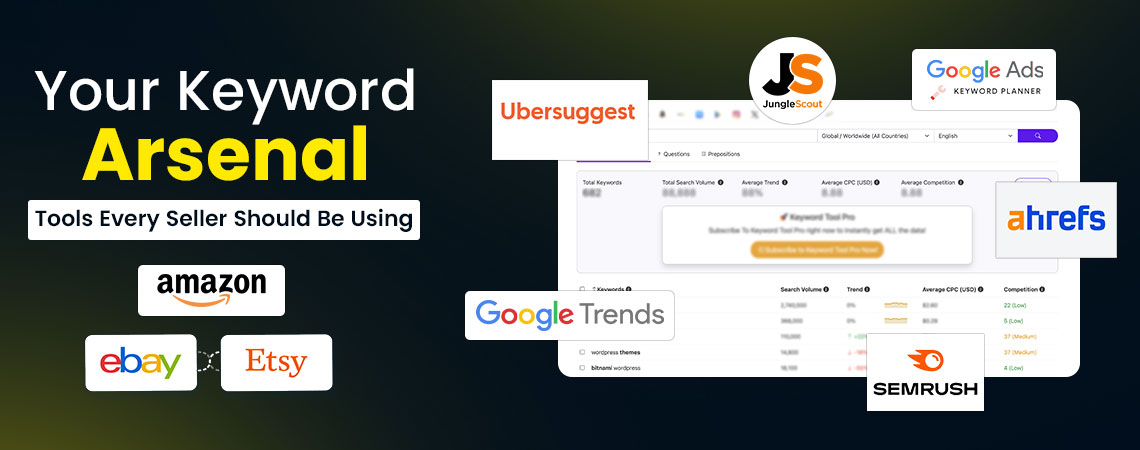
 Using the Various Resources to Land on the Right Keywords
When you choose the right keywords for your ecommerce platform, a combination of tools and techniques is a surefire way to ensure that your audience sees and is able to procure your products. Below is a selected list of practical and experimentation-tested tools to stock up your keyword arsenal:
Search Engine & Marketplace Tools
- Google Keyword Planner Gives averages of searches, degree of competition, and related keyword suggestions.
- Amazon Autocomplete Begin typing in the search bar on Amazon to see live keyword suggestions.
- eBay and Etsy Search Suggestions Useful for niche product keyword ideas.
- Google Trend This will help you find nifty things, such as seasonal and trending keywords for your category.
- Helium 10 Covers the upper side of keywords to help Amazon sellers by giving detailed analytic metrics for search volume, keyword rank, and competition.
- Jungle Scout Presents an extreme range of keyword information with keyword tracking and market trends specific to Amazon.
- Ahrefs Great for SEO based e-commerce, excellent for giving backlink and search information.
- SEMrush Maintains competitor keywords, search volume, and rank difficulty.
- Ubersuggest A very pocket-friendly tool that offers keyword suggestions and competitor analysis.
This is a must-read for e-commerce sellers looking to optimize their product listings and maximize visibility.

5 Key Strategies for Keyword Research to Increase Your Visibility on Amazon
Using the right keywords is necessary to achieve success with your products on Amazon. Don't just look for high search volume - look for buyer intent and competition, and whether the product is in season or out of season. Below are a few practical suggestions to take your keywords to the next level and gain real traction.
1- Begin with Buyer Intent Keywords
- Don't chase traffic, chase keywords that represent the stage of the purchasing decision for a shopper.
- Optimally use terms like "buy", "best", "for [use case]" to attract users who are ready to buy.
2- Use Competitor Listings as your Keyword Goldmine
- The competitors have already done the testing for you, so why not reverse engineer their listings?
- Explore their titles, bullet points, and backend keywords to see what they are doing that gets them ranking.
3- Prioritize 3–5 Word Long-Tail Phrases
- Don't use spreads, go niche.
- Long-tail keywords (i.e., "vegan protein powder for women") have less competition and have a higher rate of conversion.
4- Update Keywords on a Monthly Basis Based on Performance
- Remember that keywords require consistent optimization.
- Always be tracking performance with Google Analytics and updating your keywords monthly to align with changes in trends and buyer behavior.
5- Test Your Titles with A/B Keyword Combinations
- Your product title is a valuable place to play with different keyword combinations.
- Run A/B tests using Amazon Experiments or additional third-party tools in order to see which tells the best story in regards to converting customers.
Value of Keyword Selection for the Brand
The concept of keywords isn't so novel; it's evolved along with the digital marketplace. Businesses from small startups to multinational companies-will build their SEO strategy for ecommerce brands based on the search keywords for ecommerce brand that need to be targeted in order to reach potential buyers. Choosing the right keywords ensures that when customers search for them, they will find your product, thereby enhancing traffic and conversion rates.
Amazon Keyword Research Strategy
Structured keyword research makes it imperative to optimize an Amazon product listing through this process: selection and identification of the 20 competitors, relevant keyword extraction, and further refinement of the selection for visibility and search ranking improvement. Using power tools such as Helium 10 Cerebro and Magnet, sellers can collect competitors' data for high-ranking keywords analysis. The following steps provide some systematic ways keyword research and optimization can be conducted.
✔️ Step 1: Competitor Analysis
So, listing the top 20 competitors selling more or less similar stuff is the first step. Check twice whether each of these competitors wears the market presence, selling in Amazon seriously. You should collect and list their ASINs (Amazon Standard Identification Numbers) for further keyword analysis. These will be replacements for knowing the keywords behind that bring traffic and conversions through that product.
✔️ Step 2: Utilizing Helium 10 Cerebro
Once ASINs are gathered, the next step is Helium 10 Cerebro to extract other keywords for search. This tool gives data on those keywords for which competitors are indexed and ranked. A keyword report is produced, manually selecting the top unique high-volume keyword. For effective results, a keyword filter for organic rank 1-50 must be applied, which shows the competitor keywords ranking on the first page of the Amazon search results. This way, the most serious keywords that need to be optimized should be focused upon.
✔️ Step 3: Identifying Magnet Keywords
After collecting the competitor-based words, focus is now devoted to the Magnet words that would get more opportunities. The primary keyword with the highest searches should then be placed in the Helium 10 Magnet tool, which would generate a broader set of relevant keywords that may otherwise not have been identified in the Cerebro analysis. The extra relevant keywords (Magnet report) would also have a similar manual selection done for them so that only the most relevant ones are kept for optimization.
✔️ Step 4: Final Keyword Optimization
Eventually, the keywords extracted from Cerebro and Magnet are combined and cross-checked in the keyword optimization process. Keywords are prioritized by taking into account search volume, relevance, and competitor rank data, thus allowing sellers to have the most effective keyword set for the product listing as a whole. These final keywords make a world of difference in exposing the product to the right target audience, boosting search rankings, and gaining bigger sales on Amazon. This reviewed approach lets the seller create a well-optimized listing and stand out amongst other competing sellers in today's fast-paced market.
What Do You Gain when you Choose the Right Keywords Products?
In ecommerce branding, the understanding of keywords is an added advantage to the seller! Easy conversion for product descriptions with better SEO services Amazon and visibility will start for them. We implement these strategies, which will go a long way in helping with keyword selection and impacting the brand's disappearing success story.
Common Challenges for Keyword Strategy
Many sellers reach out to us with common keyword problems. Selecting proper keywords for their online businesses has brought serious challenges to sellers, whether they are new or existing ones. The ultimate goal is to use the best keyword strategy to draw in sales.
Choosing the Right Niche Keywords
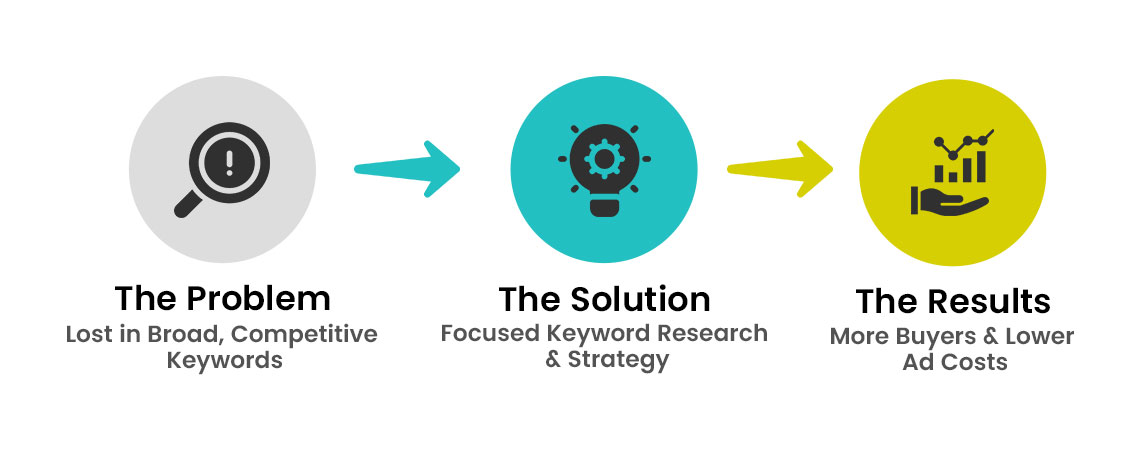
One major challenge e-commerce sellers face is selecting the correct keywords that fit their niche. If the keywords are too broad, their products may get lost among thousands of similar listings. On the other hand, if the keywords are too specific, they might not get enough traffic. Sellers reach out to us while having difficulty striking the right balance, especially for those who are new to the market.
Using Keywords Effectively
Even after selecting keywords, sellers struggle with where and how to place them. Incorrect keyword usage can result in low search rankings, reducing visibility. They also overuse keywords, making the content look unnatural, while poor placement can fail to attract potential buyers. Understanding how to upgrade Amazon main product image CTR and optimize content for search engines is a challenge to them that requires expertise.
Real-World Success Story: How Spectrum BPO Helped a Coffee Bean Seller Brew Up Sales
Client Overview
We came across a devoted small-batch coffee bean seller (David) on Amazon with a passion for quality and origin, who struggled to be found in a crowded marketplace.
The Challenge
Even with an amazing product, David fell under broad competitive keywords such as "coffee" and "roasted bean". His unique story and premium beans weren't being delivered to the right audience.
How Spectrum BPO Helped
- We took the time to learn about their brand, their passion for ethical, single-origin beans, and the story behind each roast.
- Conducted keyword research that mattered to intent, not just data.
Identified niche, high conversion terms like:
- "organic single-origin Ethiopian coffee beans for pour over brewing"
- Strategically inserted these keywords into product titles, listings, and PPC ads.
What We Accomplished
- A 40% jump in conversion rates as more intentional buyers found the product.
- 27% drop in ad costs to make room for brand growth.
- Surge in organic visibility on Amazon in highly relevant, low-competition search spaces.
Words from David
“We knew our beans were special, but we just couldn’t get in front of the right people. Spectrum BPO essentially helped us tell our unique story in a way that Amazon shoppers understood, and it worked.”
Overcoming Keyword Strategy Challenges: A Systemic Approach
One must pay attention to long-tail keywords to overcome the problem posed by competition. Long-tail keywords are longer search phrases that are relatively more specific than single keywords. Generally, long-tail keywords have lower traffic volume. Therefore, they represent the audience that is in it for searching intents. To address it sensibly:
- Use a balanced combination of broad and long-tail keywords.
- Monitor and update keyword strategy with analytics.
- Updates on changes with search engine algorithms.
- Avoiding keyword stuffing that would negatively affect SEO.
- Being open with experts such as SpectrumBPO, who are specialized in advising the keywords for ecommerce brand yielding results.
SEO Roles In Keyword Success
Search Engine Optimization, or SEO, is one of the most important factors in keyword selection and application. Sellers come to us requesting Amazon listing optimization service for their brands. We advice them that right keywords will optimize their search, such as finding an improved search engine ranking, thus leading to easy location by potential customers. Track your search keywords for ecommerce brands with tools and adjust your strategy throughout the year. This will maintain your keywords relevant enough to keep them in good performance. Quality optimized content using your keywords will give you a higher position in the search engine, along with great visibility for your brand.

Quick Tips for Keywords Selection for the Brand
Here are a few quick tips for sellers when selecting keywords for ecommerce brands:
- Identify target audience and learn their demographic.
- Use various keyword research tools to get the right keywords with a high-volume.
- Use long-tail and niche keywords to get conversions.
- Create high-quality content and incorporate keywords naturally.
- Review keywords for ecommerce brands with regularity and modify them based on performance.
 Choose Keywords Wisely!
We pay close attention to the question of How To Choose the Keywords for Ecommerce Brand. It can simply make or break situation for your ecommerce business. SpectrumBPO helps suggest the keywords for ecommerce brand by analyzing search trends and competition in your industry. We jot down your niche requirements and touch those untapped keywords for higher ranking and targeted sales. With expert advice, you can be assured of optimizing your ecommerce brand with the best keywords, which will result in increased visibility and sales. If Keyword research is giving you a nervous breakdown, looking towards professional help sure does make a difference.
Share this Post




Blog Categories
Uncategorized

