
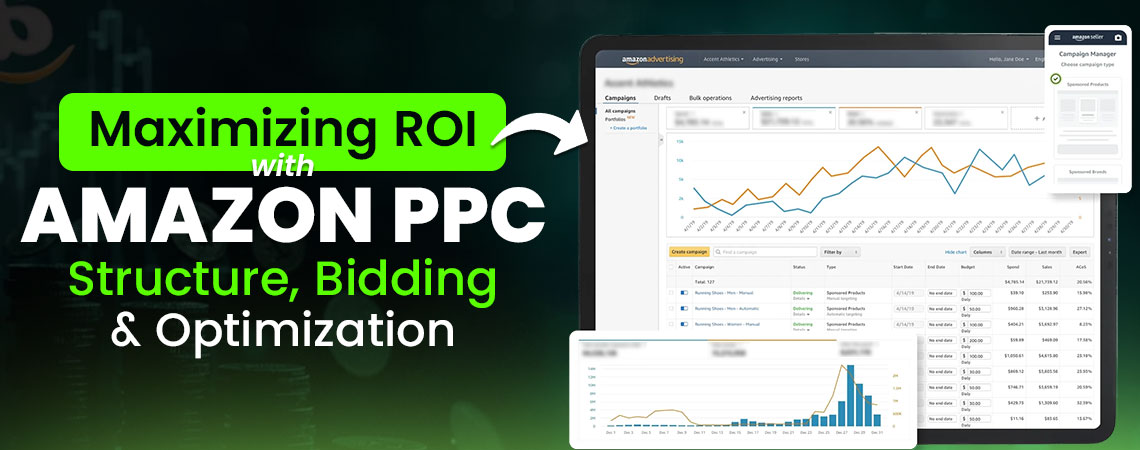
How Amazon PPC Campaign Structure & Optimization Work
Mastering Amazon PPC Campaign Structure & Optimization is crucial for sellers looking to maximize their ROI and take over search results. To successfully optimize Amazon advertising strategy requires an understanding of campaign types, a rock-solid keyword research strategy, and meticulous bid management. Reading this will provide you with effective ways you can turn a PPC campaign from virtually nothing into a money-making machine.
You need to Initiate with automatic campaigns for 2-3 weeks to identify successful search terms to transfer to manual campaigns, while also adding poor performers as negative keywords. Maintain ACoS under 30%, and allocate 10-15% of expected monthly revenue for ads, optimizing campaigns 2+ times weekly to prevent wasting ad budget and on spending that does not optimize profit.
Whether you are setting up PPC for Amazon sellers for the first time, or looking to refine existing campaigns, the structure of the journey you are about to depart on will improve the accountability of your campaign and provide you with measurable results. Smart Amazon PPC management can improve your visibility, decrease (and solidify) your ad spend, and increase your sales conversions by substantial margins, if applied correctly. You may want to keep some deciding factors in mind while hiring a PPC manager to think before you spend your hard earned dollars.
 Understanding Your Seller Journey
Regardless of whether you're just starting your Amazon adventure as a new seller or you're an experienced seller trying to understand how to improve your results, Amazon PPC campaign structure and optimization looks different depending upon where you are in your present Amazon journey. New sellers are going to have an easier time learning the basics and implementing simpler campaigns, while existing sellers can implement more complex strategies about negative keyword optimization and dayparting.
New sellers need to start using automatic campaigns to see the keywords that Amazon thinks are most relevant to their product. Existing sellers can draw upon that data to create targeted manual campaigns. Finally, for both new sellers and existing sellers, it is important to understand that PPC for Amazon sellers takes time and effort, testing and optimization is a continuing process.
Finding Official Information and Resources
There are a number of official monitoring capabilities to help you master your Amazon advertising strategy. The Amazon Advertising Console will give you more measurement and report features, as well as your campaign management, then you will know what to do with. The Seller University offers free training materials giving you everything from the basics of advertising to advanced advertising strategies.
If you're going to utilize professional services like Amazon advertising managed service provider, they will ease you into using those numbers of Amazon formal resources, including training material from the Amazon Seller University, especially if you're just starting with small campaigns or multiple campaigns that are complicated enough.
Core Elements of Amazon PPC Success
Amazon has three campaign types: Sponsored Products, Sponsored Brands, and Sponsored Display. Sponsored Products are ideal for beginners because they show a specific individual product in the search results. Sponsored Products should be the backbone of your Amazon PPC strategy.
In creating your campaigns, you will want to organize by product categories or profit margins. This will help optimize Amazon ads, where you can adjust bids and budgets based on the performance of each product. Set up separate campaigns for your best selling products and new product launches.
Choosing the right keywords is essential to the success of your campaigns. You will want to start with an automatic campaign so your customers will show you what search terms they are using to find your brand and product. After running your automatic campaign for 2-3 weeks, you will be able to have a good supply to pull the best-performing keywords and create manual campaigns.
Look for keywords that have a good amount of searches but are not too competitive. When choosing keywords, long tail keywords are always a great option for new sellers, as they are cheaper, and entice customer specificity about what they are looking for.
Set daily limits based on your profit margins and how much you're comfortable spending. A good rule of thumb is to budget 10-15% of what you're expecting in monthly revenue towards acquisitions. For example, if you expect $10,000 in monthly revenue, you might set your maximum bid at $1,000.
Start with Amazon's suggested amount for your bidding and adjust based upon the numbers as your campaign progresses.
Higher bids do not mean better results. Sometimes cutting back on bids can improve profitability without damaging your ad placement, so keep this in mind as you manage your campaign.
Optimization can only improve performance if you are doing it regularly, ideally 2 or more times a week. Spend some time during each review to look closely at the keywords that are spending money but not resulting in sales. You will want to add these keywords as negative keywords to eliminate wasteful spending.
Be very observant of your ACoS, advertising cost of sale, as this is essentially your goal, or the amount you are spending on advertising, in relation to your sales revenue! A good rule of thumb is to keep your ACoS below 30% (however many factors vary across product categories and profit margin) but there is no better judge of how you are doing than yourself and what you are producing.
My Journey: From Ketchup Business to Amazon Success
When I started my artison ketchup brand on Amazon three years ago, I was sure great tasting ketchup would win. My small-batch, organic tomato ketchup with smoked paprika was big with local farmers markets. However, I ended my first Amazon advertising experience with absolutely no success. I started at $800 in my first month with three sales, throwing money at broad keywords like "gourmet condiments."
I decided to take help from a trusted ecommerce growth agency on one of my friends recommendation and the results were beyond my imagination. Firstly, they did a deep review of what wasn't working for me. The ads were not reaching the right audience and the targeting did not work, or I did not have the tracking in place to know. So I was only wasting ad spend, and getting no relevant leads or conversions from ad campaigns. Then they put my campaigns together using highly specific phrases like "sugar-free artisanal ketchup" and "organic tomato ketchup small batch." These longer keywords had much lower competition, and were connecting with customers that were searching for exactly my product. The results were substantial: I moved my click-through rate from 0.8% to 3.2%, almost doubled my conversion rate, and reduced my ad cost per acquisition by 60% while tripling my monthly sales. Overall, there is a lot to learn, and the whole experience changed my thinking that a successful Amazon advertising strategy isn't about casting the widest net, but really understanding who your customer is and reaching them where they are already looking.
Common Challenges Faced by Sellers and Solutions
A lot of sellers struggle with high advertising costs that reduce their profits. This usually happens because sellers are bidding too aggressively on competitive keywords or are not managing their negative keywords correctly.
Solution: Initially, keep your bid price low, and increase it based on individual performance. Set up your automatic campaigns to discover new keywords that are less expensive that competitors may not necessarily be using. Always monitor and manage your negative keywords, and you will reduce wasted ad spend by approximately 20 to 30%.
It's frustrating when your ads show up on the back side of a budget and you are still getting great conversions, but sometimes your ads don't even show up in search results at all, and often advertisers are baffled, and do not know what to do. This can often happen when your product listing is not optimized correctly or when your keywords are fiercely competitive.
Solution: Work with a good Amazon listing audit service to improve your product pages. It is best to start with a less competitive, long-tail keyword, and once you gain traction, move to the broader search terms.
Without an organized campaign, there's no way to effectively optimize Amazon ads. You cannot tell the difference between which products or keywords you actually are seeing profits using when everything is lumped in together.
Solution: Begin to restructure campaigns by grouping similar products together in campaigns, and separating the campaigns by match type (exact, phrase, broad), so you will have more control over your spending and performance.
Key Points to Keep in Your Mind
The Amazon PPC Campaign Structure & Optimization is very much dependent on organization, which keywords to apply, frequent optimization, and effective decisions based on data. Start with automatic campaigns and laser focus on winning keywords. Then move to a manual campaign that is not above an acceptable budget. Always track and manage the leading cause of product profits, such as ACoS, Amazon ROAS, Net Profit, etc.
Benefits of PPC Optimization for All Sellers
PPC for Amazon sellers can provide immediate visibility that you would not be able to affordably attain for months through organic ranking. New sellers can compete with larger brand sellers on the Amazon listings without unfair advantage by honing in on the best keywords at the appropriate bid. Existing sellers can use more advanced methods to improve profitability rates, outreach, and multiple sales channels.
The value of professional management of advertising can be underappreciated. We are the company that provides Amazon agency services to allow you to run a strategically sound campaign, avoiding all the regular missteps, in a much shorter timeframe, and with proven, valuable strategies rather than trying to learn from your mistakes.
Ready to Take Action?
Are you still confused about how to implement these strategies properly? Do not allow a complex Amazon PPC Campaign Structure & Optimization problem to stifle your business growth. SpectrumBPO services are designed to assist Amazon sellers rank more profitably through our strategic management plan methods.
The SpectrumBPO services team has assisted many hundreds of sellers, to improve advertising quality, eliminate wasted advertising spending, and increase total quality sales of profitable products. Whether you are a new seller looking for effective FBA beginner plan services, or an existing seller looking for improved campaign optimization services, SpectrumBPO services can provide you with the support you need to sell on Amazon, an easily competitive marketplace.
Share this Post




Blog Categories
Uncategorized
