
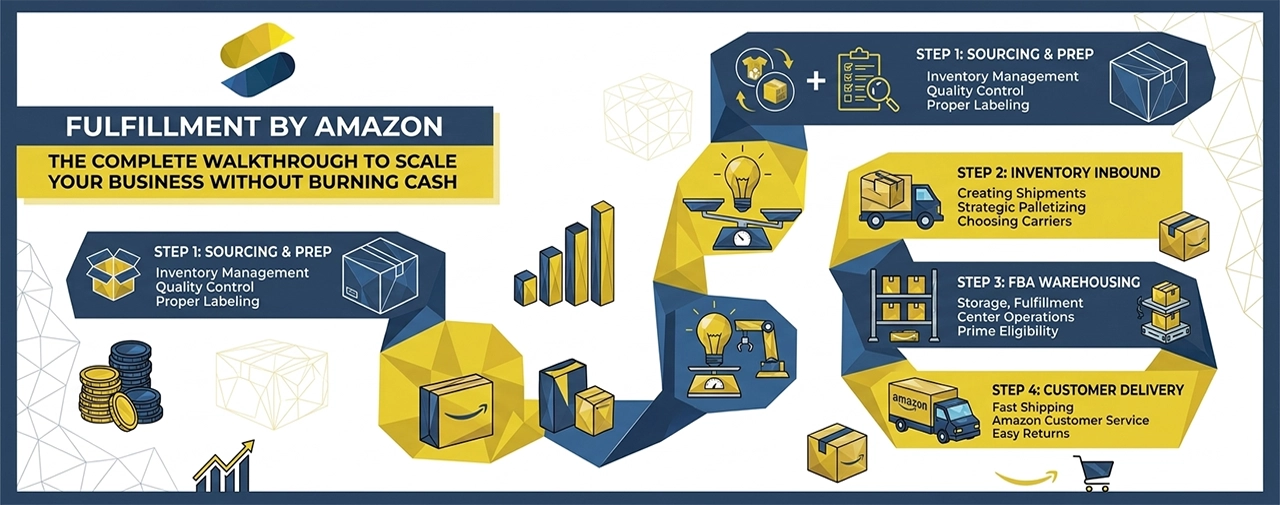
Fulfillment by Amazon: Complete Walkthrough to Scale Your Business Without Burning Cash
Every year, thousands of ambitious sellers watch their Amazon dreams collapse not because they picked the wrong product, but because they never truly understood what fulfillment by Amazon actually costs them. In 2026, Amazon quietly reshaped the entire FBA landscape, adding fuel surcharges, eliminating prep services, and raising defect fees by over 1,600%. If you are not calculating your true per-unit cost down to the penny right now, you are actively losing money on every single sale. This breaks down exactly how Amazon FBA works, what fees you will actually pay, how to find profitable products, and how to avoid the devastating mistakes that kill 80% of new sellers within their first year. More importantly, we will show you how working with the right growth partner can transform FBA from a cost center into a profit engine.
 What Is Fulfillment by Amazon and Why 2026 Changed Everything
What is Amazon FBA? At its core, fulfillment by Amazon means you send your inventory to Amazon's massive network of warehouses, and they handle every logistical detail, from storage and picking to packing, shipping, customer service, and returns. Your products earn the coveted Prime badge, which typically drives 25-40% higher conversion rates compared to non-Prime listings. This sounds like a dream setup, and for the right sellers with the right margins, it genuinely is. However, the reality in 2026 is far more complex than the glossy marketing materials suggest, especially once you factor in compliance requirements like Amazon brand guidelines that increasingly shape how listings, packaging, and even customer communication must be structured.
The Amazon FBA program has evolved into a sophisticated ecosystem with layered fees that can consume 25-35% of your sale price before you even factor in product costs or advertising. In January 2026, Amazon ended its in-house prep services entirely, forcing every seller to either prep inventory themselves, rely on suppliers, or use third-party prep centers. Then, in April 2026, a 3.5% fuel surcharge hit all FBA fulfillment transactions. When you combine this with the January fulfillment fee increases, AWD West storage jumping 19%, and transportation costs rising 22%, most sellers are paying 8-10% more per unit than Amazon's advertised 0.5% average increase.
The brutal truth is that Amazon FBA services are not inherently profitable or unprofitable. They are a tool, and like any powerful tool, they require expertise to wield correctly. A seller moving 1,000 units monthly of 6-pound products is now paying approximately $700 more per month in combined fees than they did in 2025. That is $8,400 annually in additional costs that were not in last year's business plan. If your pricing strategy, sourcing costs, or advertising budget has not adjusted for this new reality, you are running a business that bleeds money while you sleep.
Understanding the Real Cost Structure of FBA in 2026
Let us dismantle the myth that FBA fulfillment by Amazon is a simple pay-as-you-go service. The fee structure has three distinct categories, and missing any one of them will destroy your margins.
Per-Sale Fees: The Inevitable Drain
Every single unit you sell through FBA for Amazon triggers two unavoidable charges. First, the referral fee, which ranges from 8% to 45% depending on your category, with most products falling at 15%. Second, the FBA fulfillment fee, which varies dramatically based on Amazon size tiers. A small standard item under 2 ounces starts at $3.11, while large standard products over 3 pounds can hit $6.97 or more. Then Amazon stacks the 3.5% fuel surcharge on top of your fulfillment fee. For a product with a $5 fulfillment cost, that surcharge adds $0.18 per unit. At 10,000 monthly units, that is $2,100 per month or $25,200 annually in fuel costs alone.
Storage Fees: The Silent Profit Killer
Amazon fulfilment services charge monthly storage based on cubic footage. Standard-size items cost $0.78 per cubic foot from January through September, but that jumps to $2.40 per cubic foot from October through December. Peak season storage costs three times more than off-peak rates. If you have slow-moving inventory sitting in warehouses during Q4, you are essentially paying Amazon premium rent for products that are not selling. The aged inventory surcharge now kicks in at 181 days, down from 271 days in 2025, meaning your long-term storage penalties arrive 90 days earlier than before.
Conditional Fees: The Traps That Catch Unprepared Sellers
These are the fees that separate experienced sellers from those who quit. The inbound placement fee is charged to you when Amazon distributes your inventory across multiple fulfillment centers, rather than you shipping to five or more locations yourself. The low-inventory level fee penalizes you when stock falls below 28 days supply. Returns processing fees now apply more broadly, with apparel and shoes charged for every single return. And the inbound defect fee, which exploded from $0.02-$0.07 per unit to $0.32-$5.72 per unit, can bankrupt a shipment if your prep quality is not perfect.
Here is a real example of what how much does FBA costs look like in practice. Take a $25 beauty product weighing 6 ounces. Your 15% referral fee is $3.75. The FBA fulfillment fee is $4.20. The fuel surcharge adds $0.15. Monthly storage runs about $0.17. Your total FBA fees hit $8.27, leaving you with $16.73 before product cost, prep, and advertising. That is 33% of your revenue gone to Amazon before you have made a single dollar of profit.
How Amazon FBA Actually Works: From Shipment to Sale
Understanding how does amazon fulfillment works is critical because every step contains a potential failure point that costs you money. The process begins when you create a shipping plan in Seller Central. Amazon tells you which fulfillment centers to send your inventory to. You prep your products according to strict guidelines, including proper labeling, packaging, and bundling. Since January 1, 2026, Amazon's FBA program no longer offers prep services at US fulfillment centers, meaning every unit must arrive fully compliant, or you face those devastating defect fees. Many sellers also integrate Amazon brand management services at this stage to ensure listings, packaging, and compliance are aligned with requirements and brand standards.
Once your shipment arrives, Amazon checks it in, which can take anywhere from a few days to several weeks, depending on warehouse congestion. Your inventory then becomes available for sale. When a customer places an order, Amazon's system automatically selects the optimal fulfillment center, picks the item, packs it, and ships it, typically within one or two days for Prime orders. Amazon handles all customer service inquiries and processes returns according to its policies. You receive payment, minus all applicable fees, typically on a bi-weekly schedule.
The critical insight here is that how does fba amazon work creates a black box around your inventory. You do not control which warehouse holds your stock, how it is packaged, or how returns are handled. This lack of control is the trade-off for Prime eligibility and massive operational scale. For some sellers, this trade-off is worth it. For others, particularly those with thin margins or brand-sensitive packaging, Amazon self-fulfillment or third-party logistics might be the smarter path.
Is Amazon FBA Worth It? The Honest Breakdown
The question is Amazon FBA worth it does not have a universal answer. It depends entirely on your product category, margin structure, operational capacity, and growth goals.
For many sellers exploring Amazon FBA for beginners, the platform offers an accessible way to enter without managing warehousing or shipping logistics independently. Let's examine both sides honestly.
When FBA Is Absolutely Worth It
If you sell products with margins of 20% or higher after all fees, Amazon FBA fulfillment services can be transformative. Prime eligibility alone drives significantly higher conversion rates. You gain access to Amazon's 2.3 billion monthly visitors without building your own traffic infrastructure. You can scale from 10 units a day to 10,000 without hiring warehouse staff or leasing space. For digital nomads, side hustlers, or brand owners who want to focus on product development and marketing rather than logistics, FBA removes the operational headache entirely.
The fulfillment by Amazon program also opens doors to international expansion. You can use Amazon's global network to sell in the UK, EU, Canada, Australia, and beyond without establishing local entities or negotiating international shipping contracts. This is particularly powerful for US-based brands looking to diversify revenue streams beyond the domestic market.
When FBA Becomes a Money Pit
If your product sells for under $15, the fee structure will likely eat your entire margin unless you qualify for Low-Price FBA rates. Heavy or oversized items face exponentially higher fulfillment fees, sometimes making the economics impossible. Products with high return rates, particularly in apparel or electronics, get hit with returns processing fees that compound your losses. And if you lack the capital to maintain consistent inventory levels, the low inventory level fee will punish your best-selling items precisely when they are performing well.
The honest reality is that Amazon FBA works best when you have capital, expertise, and a product with genuine differentiation. Throwing a generic private label product into FBA in 2026 is a recipe for failure. The marketplace is too mature, too competitive, and too algorithmically sophisticated for amateur approaches to succeed.
Finding Products That Actually Profit on Amazon FBA
How to find products to sell on Amazon FBA is the question that separates successful sellers from those who never launch. The old strategy of finding a product with high search volume and low competition is largely dead because every seller has access to the same data through Jungle Scout, Helium 10, and similar tools. The new approach requires deeper thinking.
Start by identifying genuine customer pain points rather than just keyword opportunities. Look for products where reviewers consistently complain about the same issue. Read one-star reviews on competitor listings and ask yourself whether you can solve that problem. Consider micro-niches where passionate communities exist, but major brands have not yet invested. The carnivore electrolytes case study from 2026 is a perfect example, where 2,800 monthly searches existed with zero competition, leading to $100,000 in sales within six months.
Evaluate Amazon size tiers obsessively. A product that weighs 1.1 pounds costs significantly more to fulfill than one that weighs 0.9 pounds. Packaging dimensions matter just as much as weight. Reducing your package by half an inch can drop you into a lower size tier, saving $0.50 or more per unit. At scale, these savings transform your entire business model.
Calculate your true all-in cost before you ever contact a supplier. Factor in product cost, shipping to Amazon, prep costs, referral fees, FBA fulfillment fee, fuel surcharge, storage, estimated returns, advertising, and your desired profit margin. If the math does not work on paper, it will not work in reality. Use the fulfillment by Amazon revenue calculator and the fulfillment by Amazon calculator to model different scenarios before committing capital. Budgeting for Amazon listing optimization services during your launch phase can also improve conversion rates, keyword rankings, and long-term profitability.
The Complete FBA Fee Chart: 2026 Edition
Understanding the FBA fee chart is non-negotiable for profitability. Here is the current landscape for standard fulfillment fees, excluding the Low-Price FBA discount and apparel variations.
Small standard items start at $3.11 for 2 ounces or less and climb to $3.65 for 14-16 ounces. Large standard items begin at $3.68 for 4 ounces or less and escalate to $6.92 plus additional per-ounce charges for products over 3 pounds. Large bulky items start at $9.61 plus weight intervals, while extra-large products can reach $194.95 or more, depending on dimensions.
The Low-Price FBA program offers discounted rates for products under $10, saving approximately $0.77 per unit compared to standard rates. However, your product must genuinely fit the low-price model. Attempting to force a $25 product down to $9.99 to qualify will destroy your margin rather than improve it.
For dangerous goods, fees run higher across all tiers. A small standard dangerous good at 2 ounces costs $4.03 compared to $3.11 for standard products. These premiums reflect Amazon's additional handling requirements and compliance costs.
Shipping to Amazon FBA: The Process That Breaks Most Sellers
FBA how to ship to Amazon is where theory meets reality, and most new sellers make expensive mistakes. You begin by creating a shipment plan in Seller Central, specifying your products, quantities, and whether you want Amazon to distribute inventory or if you will ship to multiple locations yourself. Amazon then provides destination warehouse addresses and shipping labels. Sellers who use Amazon logistics and fulfillment services avoid costly missteps early in the process.
Since the 2026 prep service elimination, you must ensure every unit meets FBA requirements before it leaves your facility or your supplier's warehouse. This includes scannable barcodes, proper polybagging for certain categories, suffocation warnings where required, and loose-item containment. A single non-compliant shipment can trigger hundreds or thousands of dollars in defect fees.
You have three main shipping options. Small-parcel delivery is for lighter shipments and uses carriers like UPS or FedEx. Less-than-truckload (LTL) suits medium-volume sellers with palletized freight. Full truckload (FTL) serves high-volume operations. Each option has different cost structures, transit times, and Amazon check-in requirements. Choosing the wrong method can delay your inventory availability by weeks, costing you sales during peak periods.
Amazon FBA vs Self Fulfillment: Making the Right Choice
Amazon self-fulfillment, also known as Fulfillment by Merchant (FBM), means you store inventory in your own space and ship orders directly to customers. This gives you complete control over packaging, branding, and customer communication. You avoid FBA storage fees, long-term storage penalties, and inbound placement charges. However, you lose Prime eligibility unless you qualify for Seller Fulfilled Prime, which requires meeting strict performance metrics.
When comparing Amazon FBA vs FBM, the right choice often depends on your product margins, operational capabilities, and long-term growth strategy. For sellers with very high-margin products, existing warehouse infrastructure, or brand experiences that require custom packaging, Amazon self-fulfillment can be more profitable than FBA. For sellers starting from scratch, selling lightweight, high-demand products, or lacking logistics expertise, FBA typically generates more revenue despite higher fees.
Many successful sellers use a hybrid approach, fulfilling certain SKUs through FBA while handling others themselves. This strategy lets you optimize each product's profitability based on its specific economics rather than forcing a one-size-fits-all solution.
Case Study: How SpectrumBPO Transformed a Struggling FBA Business into a $2.4M Brand
In early 2025, we were approached by a home-goods seller based in Austin who had been on Amazon for 3 years. Their revenue had plateaued at $80,000 monthly, and their profit margins had compressed to 8% due to poor inventory management, oversized packaging, and unoptimized advertising spend. They were on the verge of quitting FBA entirely.
Our first action was a complete audit of their FBA fee structure. We discovered they were shipping products in packaging that pushed them into a higher Amazon size tier by just 0.3 inches. By redesigning their boxes to fit the smaller tier, we reduced their FBA fulfillment fee by $1.24 per unit. At 3,000 monthly units, that was $3,720 in immediate monthly savings with zero impact on product protection.
Next, our catalog team restructured its entire listing strategy by applying Amazon SEO services techniques to improve discoverability and rankings. They had been treating Amazon like a catalog rather than a search engine. We rewrote their titles, bullet points, and backend keywords to capture high-intent search traffic they were completely missing. Within 60 days, their organic sessions increased 47%, reducing their advertising dependency.
The real transformation came from our POD-based delivery model. We assigned them a dedicated team, including a fractional Head of eCommerce, a Brand Manager, a PPC Manager, and a Catalog Manager. This team met weekly to review performance, adjust inventory forecasts, and optimize ad spend. When Amazon announced the 2026 fee changes, we had already modeled the impact and adjusted their pricing strategy three months in advance. While their competitors scrambled to absorb unexpected cost increases, our client had already built the new economics into their model.
By March 2026, their monthly revenue hit $200,000 with margins restored to 22%. Their annual run rate crossed $2.4 million. The key insight from this case study is that Amazon FBA success is not about finding a magic product. It is about operational excellence, strategic planning, and having experts who understand the platform's evolving mechanics.
What makes our approach different at Amazon Agency is that we do not charge upfront fees for new partnerships. We offer a one-month test period where you experience our full service delivery without any initial commitment. After 30 days, you decide whether our expertise justifies the investment. This model exists because we are confident in our ability to deliver measurable results, and we believe growth partnerships should be earned, not sold.
The Hidden Costs Nobody Talks About
Beyond the obvious fees, Amazon FBA sellers need to understand several stealth costs that appear only after they are committed. Payment timing has shifted to DD+7 in 2026, meaning you wait longer for revenue after sales. The removal and disposal fee timing changed in March 2026, making it harder to liquidate slow inventory quickly. SIPP certification, while saving $0.25-$1.32 per unit, requires upfront investment in packaging design and Amazon's approval process.
Returns processing for non-apparel categories now triggers fees when your return rate exceeds category thresholds. If you sell in a high-return category without monitoring this metric, you can suddenly face charges you never budgeted for. The Overmax handling fee, effective January 2026, adds $17-$25 per unit for extra-large products exceeding dimensional limits, turning marginally profitable items into clear losers.
These hidden costs are why we always tell prospective clients that what is the amazon fba program is only half the question, and why many sellers turn to Amazon reconciliation services to accurately track fees, adjustments, and discrepancies across their accounts. The other half is understanding whether your specific business model can absorb the platform's full cost structure while still generating meaningful profit.
How to Calculate Your True FBA Profitability
Accurate profit calculation separates thriving sellers from those who discover they are losing money six months too late. The formula is straightforward but requires rigorous data tracking.
Start with your gross revenue, then subtract the following:
- Product cost (including shipping to warehouse or prep center)
- Referral fee (based on category percentage)
- FBA fulfillment fee (current rate card)
- 3.5% fuel surcharge (applied to fulfillment fee)
- Monthly storage costs (based on cubic footage and season)
- Estimated returns processing (based on historical return rate)
- Advertising spend (typically 10-30% of revenue in competitive categories)
- Prep and packaging costs
What remains is your true net profit.
Use the fulfillment by Amazon calculator available in Seller Central to model specific products. Cross-reference this with the fulfillment by Amazon revenue calculator to understand long-term profitability across different price points and volume levels. Update these calculations quarterly because Amazon changes fees annually, and your product's size tier or category classification can shift.
Scaling Beyond FBA: Building a Real Brand on Amazon
The sellers who achieve sustainable success through Amazon FBA in 2026 are not treating it as a side hustle. They are building genuine brands with defensible market positions. This means investing in premium product photography, A+ Content, and storefront design that converts browsers into buyers. It means developing products that solve real problems rather than copying existing listings with minor variations.
At SpectrumBPO, our Amazon graphic design services team produces visual assets that consistently outperform generic competitor listings. Our process starts with customer research, identifying the emotional triggers and functional needs that drive purchase decisions in your category. We then translate those insights into listing content, advertising creative, and brand storytelling that builds long-term customer loyalty.
The marketplace is too competitive for half-measures. A listing with mediocre photos and keyword-stuffed copy might generate occasional sales, but it will never build the momentum required for serious scaling. Your brand needs to communicate trust, quality, and differentiation within the first three seconds a customer sees your product.
Common FBA Mistakes That Destroy New Sellers
After managing hundreds of Amazon accounts, our team has identified recurring destructive patterns across failed seller stories. The first and most damaging mistake is analysis paralysis. Sellers spend six months researching the perfect product while their competitors launch, learn, and iterate. The cost of a delayed launch often exceeds $20,000 to $30,000 in lost monthly profit.
The second mistake is inventory mismanagement. Stockouts kill your search ranking momentum and cost you thousands in lost sales. Over-ordering triggers long-term storage fees that erode margins on products that are not moving. The solution is disciplined forecasting based on historical velocity, seasonality, and lead times, not gut feeling or optimistic projections.
The third mistake is neglecting quality control. Sending defective products to Amazon results in negative reviews that permanently damage your listing's conversion rate. One-star reviews are nearly impossible to remove and compound over time, creating a death spiral where poor ratings reduce sales, which in turn reduces ranking and sales.
The fourth mistake is treating advertising as an afterthought. Organic ranking on Amazon is increasingly pay-to-play. Without strategic Amazon PPC management services, even excellent products languish on page three, where no customer ever looks. Our PPC specialists at SpectrumBPO build campaigns that scale revenue while maintaining ROAS targets, ensuring every advertising dollar contributes to profitable growth.
The Future of Amazon FBA and What Sellers Should Prepare For
Looking ahead, Amazon FBA updates will likely continue the trend of increasing complexity and cost. Amazon's logistics network is under constant pressure from volume growth, labor costs, and fuel price volatility. Sellers should expect annual fee adjustments, new surcharge categories, and tighter compliance requirements. The sellers who survive and thrive will be those who build operational resilience into their business models.
This means diversifying across multiple marketplaces rather than depending solely on Amazon US. It means developing direct-to-consumer channels that capture customer data Amazon does not share. It means building supply chain relationships that can adapt to changing requirements rather than depending on a single factory or shipping method.
The FBA program Amazon will remain a dominant force in eCommerce because the Prime ecosystem creates enormous customer value. However, success within that ecosystem requires increasingly sophisticated expertise. The days of sourcing a product from Alibaba, adding your logo on it, and watching sales roll in are definitely over.
Your Next Steps: From Learning to Launching
If you have read this far, you now understand that what is fba selling on Amazon involves far more than shipping products to a warehouse. It requires strategic product selection, meticulous cost accounting, operational excellence, and continuous optimization. The sellers who treat FBA as a serious business rather than a passive income stream are the ones building seven and eight-figure brands.
Before you launch, validate your product idea using the tools and frameworks. Model your true costs, including every fee category. Source samples from multiple suppliers and invest in quality inspection. Build listings that convert through professional creative and keyword optimization. Plan your inventory strategy to avoid stockouts and overstock situations. And most importantly, consider whether partnering with experts who live and breathe Amazon daily might accelerate your timeline to profitability.
At SpectrumBPO Ecommerce Growth Agency in Richardson, we have helped brands across every major category navigate the complexities of Amazon Marketplace fulfillment. Our 400+ in-house experts handle everything from catalog optimization and PPC management to international expansion and financial tracking. We operate on a retainer plus performance-based structure because we believe our compensation should align with your growth outcomes.
We understand that choosing a growth partner is a significant decision. That is why we do not ask for upfront fees or long-term contracts before you have experienced our value. Test our services for one month. Let our dedicated POD team show you what professional Amazon management looks like. After 30 days, decide whether the revenue growth, margin improvement, and operational peace of mind justify continuing the partnership.
The Amazon marketplace in 2026 rewards expertise and punishes amateurism. Every day you delay building that expertise is a day your competitors capture market share that becomes increasingly expensive to reclaim. The question is not whether Amazon FBA offers an opportunity. The question is whether you have the systems, knowledge, and support to capture it.
Conclusion: Making FBA Work for Your Business in 2026
Fulfillment by amazon remains one of the most powerful eCommerce tools available, but it is no longer the simple, low-barrier opportunity it was five years ago. The fee structure has grown complex, competition has intensified, and Amazon's algorithm increasingly favors established brands with professional execution. Success requires treating FBA as a serious business discipline rather than a passive income hack.
The sellers who will dominate in 2026 and beyond are those who understand their numbers intimately, optimize every operational detail, and build genuine brand value that transcends any single marketplace. They partner with experts who handle full Amazon account management when needed, invest in quality at every touchpoint, and maintain the strategic flexibility to adapt as Amazon's ecosystem evolves.
Whether you are just exploring whats amazon fba or scaling an existing seven-figure brand, the principles remain the same. Know your costs. Solve real customer problems. Execute with excellence. And never stop optimizing.
Share this Post




Blog Categories
Uncategorized
