
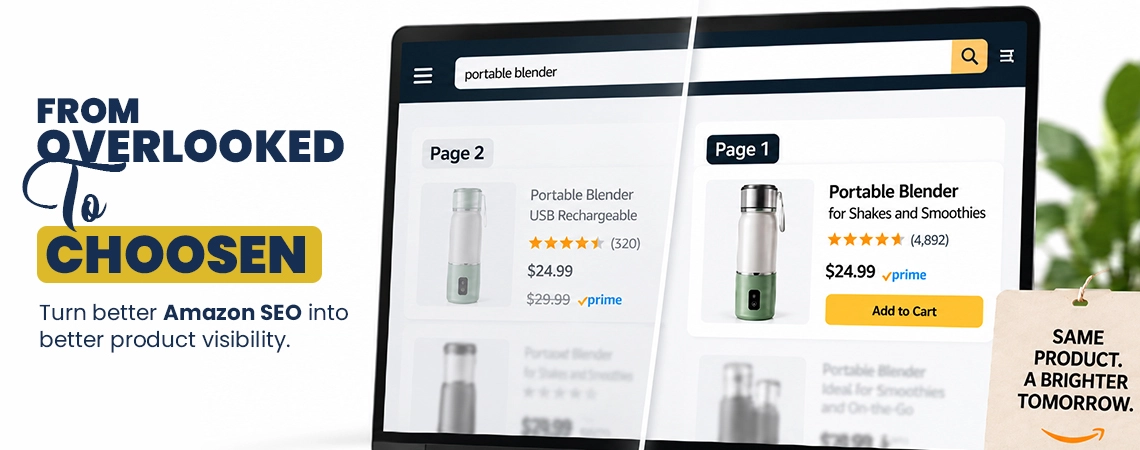
Amazon SEO: Stop Losing Buyers on Page Two. Here Is the Fix That Moves Listings to Page One
Your Amazon store is losing buyers every day if your products aren't on page 1. Most sellers burn cash on ads because they don't fix the foundation of organic ranking that brings profit. Amazon SEO is how you stop paying for every click and start getting high-intent traffic that buys.
We break down why listings fail, how brands fix them, and what our team at SpectrumBPO does differently to push products to page one. We have spent years inside Seller Central accounts, watching good products die from poor keyword placement and weak conversion signals. If you ignore these fixes, you will keep losing money, and your competitors will capture your buyers.
 What Amazon SEO Stands for and Why Most Sellers Get It Wrong?
Amazon seo stands for search engine optimization inside Amazon's marketplace. The algorithm cares about whether a shopper clicks your listing and buys within minutes. Our team at SpectrumBPO in Richardson sees this confusion daily.
Sellers come to us after spending months, they try to rank for broad terms that drive traffic but generate zero sales, stuff titles with keywords that sound good but kill readability, and treat bullets like feature dumps instead of sales copy.
This is why their listings stall. To fix these issues, you need to understand that Amazon ranks products based on two things:
- Relevance: Use the right Amazon SEO keywords in the right places.
- Performance: Shoppers buy once they land on your page.
You need these factors to sell your products because one without the other fails.
Last year, we had a client who was selling premium dog leashes. His products were ranking on page one for "dog leash," but the conversion rate was under 5%. The traffic was huge, but the buyers were not spending $45 on a leash.
We changed the Amazon SEO keyword strategies to include "heavy-duty leather dog leash for large breeds" and "soft padded handle dog leash for pulling." His 30% traffic dropped, and sales doubled.
Amazon's algorithm saw an improvement in conversion rate and pushed its products higher in search results for the new terms.
Why Your Listings Are Bleeding Money on Page Two?
Amazon sellers whose products are on page two lose sales. Data show that 80% of buyers purchase from the first page of search results. If your product ranks on 18th, you are invisible to potential buyers. You not only lose sales but also lose the organic sales velocity that signals to Amazon your product deserves to move up.
We audited a kitchen brand last quarter with 47 SKUs, and their products were on page 2. Their images were dark, titles were cluttered, and bullet points read like technical manuals.
After 30 days of restructuring their listings, 34 of those SKUs hit page one. The owner told us he wished he had called us six months earlier. Before that, he was spending $40,000 on PPC, which is where our Amazon PPC management services helped align his ad strategy with stronger organic performance.
Most sellers treat paid ads as the solution, but if your listing does not convert organically, you are paying to fix a problem that should be free. Every dollar you spend on PPC because of poor Amazon SEO is a dollar you could have kept as profit. The pain gets worse during Q4.
When holiday traffic spikes, sellers with strong organic rankings capture more sales without spending extra money on PPC. Sellers on page two panic and raise their bids. Their ad costs explode while their margins shrink.
We see this pattern every year. The sellers who prepared their organic foundation in July and August win in November. The ones who waited drowned in December.
The Real Amazon SEO Strategy That Moves Products to Page One
There is no magic button for an Amazon SEO strategy. It requires four steps that work together. Our specialists use this process for every client we accept.
First, research buyer intent. We focus on keywords that show a customer is ready to buy. For example, "best running shoes for flat feet" is more valuable than "running shoes" because the shopper knows what they want. We also use tools like Helium 10 and Jungle Scout to analyze competitor listings and reviews, which helps us to understand the words and phrases customers use when searching and buying.
Second, place keywords with intent. Put the main keyword within the first 80 characters of your product title, and use related keywords in the bullet points. Include long-tail keywords and similar terms in the backend search fields. We don't repeat keywords. Amazon's algorithm indexes each term once, so stuffing wastes space and affects readability.
Then, through Amazon creative design services, optimize your images to get more clicks. Your main product image should be clear, high-quality, and fill the frame. Use lifestyle images to show the product in real-life situations that solve a customer's problem. Add infographics that answer the common buyer questions before they read the rest of the listing. Strong images grab attention, increase clicks, and help improve your product's performance in search results.
Fourth, drive external traffic to build momentum. Amazon's A10 algorithm takes into account where your customers come from. When you bring shoppers from social media, email campaigns, or other external sources, it signals that your product is attracting interest beyond Amazon. This can help improve visibility and ranking. Our catalog manager says that Amazon SEO is like building a house, keywords are the foundation.
Images grab attention and make shoppers stop. Bullet points keep them interested and help them decide to buy. External traffic brings visitors to your listing through channels like social media and word of mouth. If one of these is missing, your listing's overall performance can suffer.
We track every title change, image swap, backend update that gets logged, and monitor rank shifts daily.
How Our Amazon SEO Specialist Team Cracked the A10 Algorithm for a Home Goods Brand?
This is the case study we share with every new seller who doubts whether organic ranking still works. A home goods brand that was based in Austin came to us in January 2025. They were selling ceramic storage containers.
Their product was beautiful, and reviews were strong. But the product was ranking on page 3 for every high-intent keyword term in their niche.
Our team of Amazon SEO specialists started with a full audit of their account. We found three problems, their:
- Titles started with the brand name, which nobody was searching.
- The bullet points focused on listing materials but didn't address the emotional benefits of an organized kitchen.
- Backend keywords were filled with irrelevant terms like "gift" and "decor," which brought in unqualified clicks.
We rewrote the title to lead with the main phrase, "Ceramic Canister Set with Airtight Lids for Kitchen Countertop," restructured the bullets to address the buyer's pain points that were: cluttered pantries and stale food, and replaced the backend terms with specific long-tail phrases like "flour, sugar, coffee, tea storage jars."
In 45 days, their primary keyword moved from position 28 to position 4. 312% organic sales increased. Their 60% PPC spend dropped. The brand owner said it felt like someone had turned on a light in a room they did not know was dark.
This is what happens when you don't treat Amazon SEO as a keyword game. We know what the algorithm rewards because we test daily. The owner now sends us photos of his warehouse expansion.
Amazon SEO Keywords: Where to Place Them for Maximum Pull
Many sellers insert Amazon SEO keywords randomly and hope for strong results. They don't realize that keyword placement follows a structured hierarchy that our catalog managers apply across every listing.
The title holds the most weight. Amazon reads left to right, so your primary phrase must appear early. Keep it under 100 characters for mobile shoppers.
Include your brand name after the main description if it's not well-known.
Bullet points are the second most important section. Every point should start with a benefit, then naturally add in a supporting keyword, do not force it. If the sentence sounds strange to a human, Amazon's natural language processing flags it as low quality.
Backend search term fields are very valuable, but they are hidden. Each field allows you to add 250 bytes. Use them for synonyms, alternate spellings, and related keywords that don't fit in your main listing text naturally.
Do not repeat words that are already in your title or bullets. Do not use competitor brand names or temporary claims like "best seller." A+ Content matters too.
For brand-registered sellers, image alt text and module headlines are indexed. We write these with the same care we give to titles. Every word should have its place.
We recently helped a supplement brand restructure its backend terms. They were using broad terms like "health" and "wellness," which attracted the wrong audience.
Our team narrowed the terms to "vegan omega 3 softgels for joint support" and "fish-free algae DHA supplement." Their 18% click-through rate increased in two weeks.
Amazon SEO Pricing: What You Should Pay for Real Results
Sellers ask us about Amazon seo pricing more than almost any other topic. The market is flooded with cheap audits and overpriced retainers that deliver nothing. We believe pricing should match performance, not promises.
At SpectrumBPO, we do not charge upfront. You can test our Amazon SEO services for one month without paying any cost. If you see movement in your rankings and sales, you stay.
If you do not, you walk away with zero risk. This is how confident we are in our systems. Most agencies lock you behind long contracts and setup fees. They bill you before they see your account. We think that is wrong. Our model ties our team to your results.
When you win, we win. A typical investment for full-service Amazon SEO management ranges based on your catalog size and market complexity.
Single-product brands need less support than multi-SKU operations expanding into Europe or Canada. We build custom plans after we audit your account.
One of our clients, a father-son tool business from Ohio, was hesitant to spend after being burned by another agency. They paid $3,000 upfront for a "full audit" that was just a PDF of their own listings. We took them on with no initial fee.
In 30 days, their main wrench set moved from page two to the top five sellers on page 1. They stayed with us for 14 months and expanded into the UK.
Amazon SEO Tools Free vs Paid: What Our Team Uses Daily
You do not need a $500 monthly fee to start any software subscription. There are many free Amazon SEO tools that provide data to help you make smart moves, but the important part is to know which tools to trust and when to upgrade.
Our specialists at SpectrumBPO start with Amazon's search query performance report. It is available inside Brand Analytics for free and shows which terms drive your sales. For paid tools, we use Helium 10 for keyword validation and Jungle Scout for competitor tracking. This approach is part of our broader Amazon brand management services, where we focus on data-driven growth instead of guesswork.
These cost around $50 to $100 per month. We do not recommend buying them until you understand how to track the data.
Here is how we rank:
- We keep SpectrumBPO's internal audit system at first. Our proprietary checklist catches issues that software misses. We combine human review with data.
- Amazon Brand Analytics ranks second. It is free and vital for sellers who have a Brand Registry.
- Helium 10 ranks third. It is best for deep keyword research and listing validation.
- Jungle Scout ranks fourth, which helps you to find sales velocity track and competitor alerts.
- Google Trends ranks fifth. It is free and perfect for seasonal planning.
We test new tools monthly. Last month, we tried a new AI image generator for infographics. It failed. The text was unreadable at thumbnail size.
The Account Health Issues That Kill Your Rankings
Amazon tracks metrics like order defect rate, late shipment rate, and customer response time. Even a small negative signal can push your products off page one within days. That's why we monitor account health daily for our clients. Track your inventory levels weekly. Respond to buyer messages within 24 hours. Keep your order defect rate under 1%.
A seller who was selling in the beauty category lost 40% organic traffic because her products were out of stock for two weeks. Amazon saw the stockout as a sign of low reliability, and her ranking dropped. With our Amazon logistics fulfillment services, we changed inventory planning and supply flow on her account, and in 60 days, her listing recovered.
Another factor is how you set product prices. When you keep prices higher than your competitors and your conversion rate drops, the algorithm interprets it as weak customer demand. To avoid this, we implement pricing strategies that protect your margins. A small price adjustment during the launch phase can help you build sales and improve ranking. Once your product stabilizes on page one, you can gradually increase pricing.
Why a Growth Partner in Richardson Builds Better Organic Assets?
Our team at SpectrumBPO in Richardson, Texas, operates from a hub that gives us direct access to major logistics networks and a deep talent pool of marketplace experts. We are not a scattered group of freelancers. We have 400+ in-house professionals who work in dedicated pods for each client.
An Amazon growth agency should operate as part of your team. Our brand managers understand your entire catalog, and PPC specialists communicate with catalog teams every day. Our creative team designs images based on real keyword data. This coordination matters because Amazon SEO is a connected system where every part affects performance.
It is a process of testing, adjusting, and defending your rank. When your agency operates in silos, you end up with broken strategies; when it operates as one unit, you get compounding results. We have a client in the fitness space whose previous agency handled SEO, PPC, and creative separately.
The SEO team wrote titles without telling the PPC team. The PPC team ran ads for keywords that were not in the listings. The creative team used stock photos that did not match the keywords. When we took over, we aligned all three. Their 22% cost per click dropped, and their organic rank for main terms improved.
Why Our Amazon SEO Experience Matters for Your Rankings?
One of our senior specialists has been working on Amazon listing optimization services since 2017. He can look at a title and tell what's keeping it from selling. He has seen every mistake and strategy over the years. That kind of experience is what you get with a serious agency. You're not just paying for tools, you're paying for years of understanding and experience.
- We have managed over 1000 + Amazon accounts since 2017 and have seen algorithm updates, policy changes, and category shifts.
- Our specialists are certified in Amazon advertising, catalog management, and brand registry processes. We train weekly on new features, such as Amazon's AI-generated listing tools.
- Brands trust us because we publish real results, share case studies, and speak at ecommerce events. Our name appears in discussions about serious Amazon growth.
- We do not lock you into contracts or hide your data. You get reporting and direct access to your pod team.
How Alexa Shopping Changes What Amazon SEO Means in 2026?
Now buyers ask Alexa to reorder products, find deals, and search by category. If your listing is not tuned for voice, you are missing a growing segment of buyers who never type a single keyword. We help sellers prepare for this shift. As Alexa replaces Rufus, this shift will only grow.
A typed search might be "stainless steel water bottle." A voice search is "Alexa, find me a leak-proof water bottle that keeps ice cold for 24 hours." Your listings need to answer these questions.
We structure bullet points and A+ Content to match natural speech patterns, including common question phrases in backend fields.
This positions your products for typed and spoken search. As Alexa+ shopping expands, early movers will dominate.
A pet supply client of ours tuned for voice last quarter. They added phrases like "dog bed that washes easily in the machine" and "cooling mat for dogs that overheat in summer." Their 62% voice-originated sales increased.
The One Mistake That Destroys New Listings Before They Start
New sellers launch with perfect photos and zero keyword research. They assume a good product will sell itself. It will not.
Amazon needs signals. Without the right Amazon SEO keywords in your title from day one, the algorithm has no idea who to show your product to. You end up burning through your launch budget with no organic backup, and later having to rely on Amazon reconciliation services to fix avoidable listing and account-level data gaps.
We always tell clients to spend twice as long on keyword research as they do on photography. The prettiest listing in the world means nothing if nobody sees it. Get the words right first. Then make it beautiful.
Ready to Stop Losing Buyers to Page Two?
Every day you wait, your competitors solidify their rank. They are capturing the buyers who should be yours. They are building review velocity that becomes harder to match. They are not standing still, and neither should you.
We want to help you fix this. Our team at SpectrumBPO will audit your account, rebuild your listings, and track your rank growth for 30 days. You pay nothing up front. You only continue if you see real movement. What is the one keyword you wish to rank on page one? Tell us in your consultation request, and we will show you how we would get you there.
Share this Post




Blog Categories
Uncategorized
