
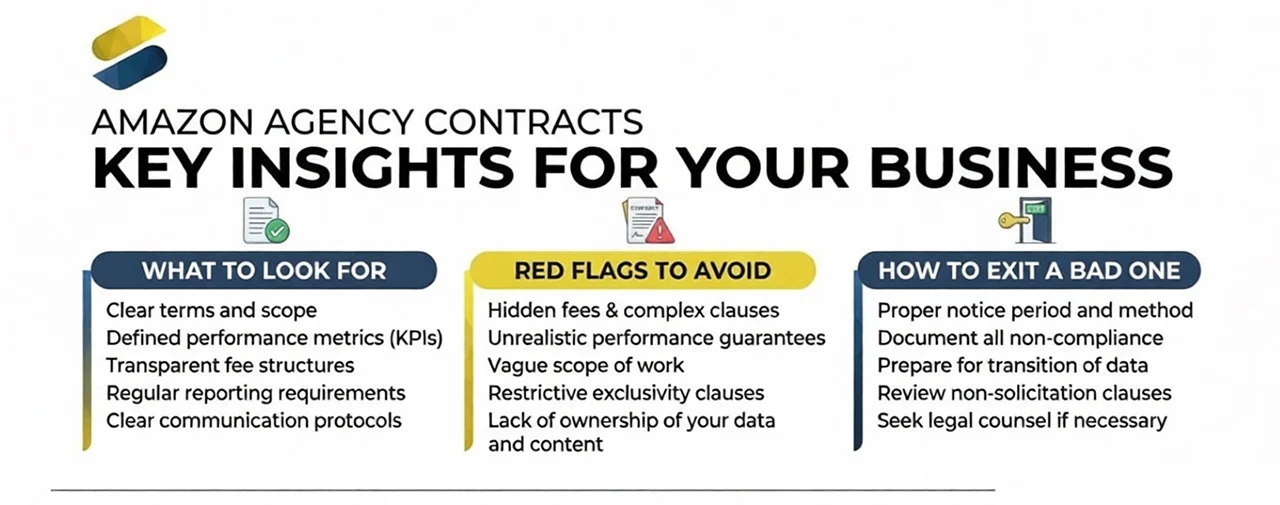
Amazon Agency Contracts: What to Look For, Red Flags to Avoid, and How to Exit a Bad One
Amazon's success isn't just about what you sell, it's about who you trust to help you sell it. Most Amazon sellers lose their money because they sign the wrong agreement at the wrong time. The truth is, Amazon agency contract red flags are quietly draining revenue, locking brands into poor performance, and in some cases, putting entire Seller Central accounts at risk.
We've worked with hundreds of sellers who came to us after being stuck in contracts that looked fine on paper but were designed to protect the agency, not the brand. And by the time they realized it, they had already burned months of ad spend, lost rankings, and struggled to regain control.
This is where understanding the fine print of a full-service agency vs freelancer comparison becomes the difference between scaling and stalling.
 The Reality Behind Most Amazon Agency Agreement Terms
On the surface, most Amazon agency agreement terms sound reasonable. Dedicated managers. Growth strategies. Full-service support. But what matters is how those terms are structured.
Many agencies build contracts that prioritize retention over results. That means long lock-in periods, vague deliverables, and unclear asset ownership.
At SpectrumBPO Ecommerce Growth Agency in Richardson, we've seen firsthand how these agreements create friction instead of growth. That's exactly why our approach is different. We operate on a no-upfront fee, one-month trial model, so you can evaluate performance before making any commitment. There are no long contracts, and you're free to discontinue at any time, no questions asked.
The Most Overlooked Amazon Agency Contract Red Flags
Some Amazon agency warning signs are obvious. Others are hidden in the legal terms that most sellers skip.
One of the biggest risks is access control. Agencies often request full admin permissions inside Seller Central without clearly explaining what that means. Understanding Seller Central access for agencies is critical. A professional Amazon SEO agency only needs specific user permissions, not complete ownership, even when managing your full account or optimizing a single aspect of it.
Another red flag is unclear accountability for performance. If your contract does not define measurable outcomes like TACoS improvement, conversion rate growth, or organic ranking progress, you're essentially paying for activity, not results.
We've also seen contracts that make it difficult to terminate the Amazon agency safely, with penalties, delayed access removal, or even threats to withhold data.
Case Study: How a $85K/Month Brand Escaped a Bad Contract
One of our clients came to us after being locked into a 6-month agreement with a traditional agency. On paper, everything looked solid. In reality, their sales dropped by 32 percent within 90 days.
The problem wasn't just poor execution. It was structural.
The agency had full control over listings, ads, and even backend data. When performance declined, the brand had no visibility into what was being done. Worse, their contract made it difficult to leave without paying a hefty exit fee.
Our team stepped in and audited everything. From listings handled under Amazon listing services to ad campaigns managed through an external system, we identified misaligned strategies across the board.
Our in-house specialists rebuilt their structure. Within 120 days, the brand not only recovered but scaled to $140K/month with improved margins.
The biggest win was not just growth. It was control. The client finally understood what was happening inside their account.
How to Exit an Amazon Agency Contract Without Losing Everything
Knowing how to exit Amazon agency contract situations is one of the most searched concerns among sellers, and for good reason.
The key is to act strategically, not emotionally.
Start by reviewing access levels. Ensure your primary account ownership is secure. Then document everything. Campaign data, listing content, reports. This protects your brand during transition.
At SpectrumBPO, we've built a clean offboarding system specifically to address this fear. When clients leave, they retain full access, full data, and full continuity. No hidden clauses. No disruptions.
This is also why we emphasize our no lock-in approach. You can terminate Amazon agency safely because we never rely on contracts to retain clients. We rely on results.
Why Most Sellers Regret Not Reviewing Contracts Properly
There's a pattern we've noticed after working with hundreds of brands. A common issue arises in a full-service agency vs. freelancer comparison when sellers evaluate options without closely examining the agreement structure.
That's where problems begin.
If you've ever wondered why agencies fail to deliver, it often comes down to misaligned incentives. If they get paid regardless of performance, there's no urgency to optimize.
That's why we built our systems differently at SpectrumBPO Ecommerce Growth Agency in Richardson. Our team includes Amazon PPC agency specialists across brand growth, performance marketing, and operations. Every function works together toward one outcome, which is measurable growth.
Second Case Study: From Stagnation to Structured Growth
Another client came to us stuck at $40K/month for over a year. They had worked with multiple agencies, each promising scale but delivering inconsistent results.
The issue was not effort. It was fragmentation.
Listings were handled by one provider. Ads by another. Branding was completely ignored.
We stepped in with a full-funnel strategy, aligning everything from creatives to backend structure. Our design team improved visual assets through Graphic design services for Amazon, while our performance team restructured campaigns and keyword targeting.
Within 6 months, the brand crossed $110K/month with a stable growth trajectory.
But the most important shift was clarity. The client finally understood where revenue was coming from and how to scale it further.
What a Seller-Friendly Contract Actually Looks Like
A strong contract does not lock you in. It protects both sides.
It clearly defines deliverables, access levels, integrates Amazon brand management services where needed, performance expectations, and exit terms.
At SpectrumBPO, we go a step further. We remove the biggest barrier entirely. No upfront fees. A 1-month test model. You evaluate us based on real performance, not promises.
That's how trust should work in this industry.
Final Thoughts: Don't Let a Contract Decide Your Growth
The difference between scaling and struggling often comes down to decisions made before the work even begins.
Understanding how to track your agency's monthly performance is not just about avoiding bad agencies. It’s about protecting your brand, your revenue, and your long-term growth. It's about protecting your brand, your revenue, and your long-term growth.
The right partner will never trap you in a contract. They will give you clarity, control, and results.
FAQs
Lack of clear deliverables, requests for full admin access, long lock-in periods, and no performance benchmarks are major red flags.
Ask for real case studies, client references, and detailed performance metrics, not just testimonials. We make this process easier for you through live account audits and a post-payment model rather than relying solely on static success stories.
This usually happens due to misaligned strategies, poor PPC structure, or inconsistent listing optimization. In some cases, agencies also over-control the account without clear communication, making it harder to diagnose issues. In our Amazon agency, our approach reduces this risk by maintaining full transparency across listings, PPC, and catalog operations so sellers always understand what's being changed and why.
Review contract terms, secure account access, document data, and follow a structured transition plan. We avoid this issue entirely by offering flexible terms, no lock-in contracts, and a clean offboarding process that allows clients to retain full control and data.
A strong contract should define clear deliverables, KPIs (like TACoS, ACOS, conversion rate), access permissions, data ownership, and exit terms. Without these, accountability becomes unclear. At SpectrumBPO, we emphasize simplified agreements with transparent scopes and flexible monthly renewals, rather than restrictive long-term commitments.
Yes, but only through limited user roles with role-based permissions. Full admin ownership should never be transferred to an agency. We follow least-privilege access practices, meaning we operate only within the permissions required for PPC, listings, or catalog work.
You should retain full control of your Seller Central account, advertising data, and listings. Problems arise only when agencies centralize ownership or restrict data access. We ensure continuity by returning full control and structured documentation so brands can transition without losing performance history.
Most agreements require 15-30 days notice, but this depends entirely on contract terms. Agencies with rigid lock-ins may impose penalties or delayed access removal. We avoid this issue by operating on flexible monthly terms, allowing clients to discontinue or renew without contractual friction.
Share this Post




Blog Categories
Uncategorized
