
Ecommerce Business Insurance
Running a successful online store gives unparalleled freedom, but it has a hidden set of risks that can wipe out your profits in a day. Many sellers focus on inventory, marketing, and web design, but they don't look into the crucial factor of e-commerce business insurance. The insurance for e-commerce is for protecting your whole digital operation. Whether you're a high-volume Amazon FBA seller, a dropshipper relying on third-party manufacturers, or a small business selling handmade goods online, you face different liabilities every other day. A one faulty product, an international shipment gets lost, or a data breach exposing customer credit cards can lead to costly lawsuits, regulatory fines, and financial ruin.
According to the Next Insurance survey held in January 2025, the findings show that 36% of small business owners believe insurance is unnecessary, which means they have a lack of awareness of real-world business risks. Most small business owners don't understand their insurance needs or carry adequate coverage. Their previous studies found that 90% of small business owners aren't confident they have enough insurance, and 96% couldn't explain general liability insurance, which is one of the most common and vital policies for business protection.
If sellers understood how critical the right insurance coverage is, they could protect themselves from risks. Knowing what insurance your e-commerce business needs can make the difference and can save you from major financial loss. Don't wait for an accident, claim, or crisis to discover your business is unprotected; build your financial safety net so you secure yourself before anything happens.
 Why Sellers Need Ecommerce Business Insurance
E-commerce has changed in every way in how we buy, sell, and build businesses. But while the opportunities are limitless, the risks are very real. Many sellers underestimate how quickly things can go wrong until they do. Having ecommerce business insurance in place means you're not left scrambling when the unexpected hits.
Imagine these common scenarios:
- A customer claims your skincare product caused a rash and sues.
- A hacker breaches your website, stealing hundreds of customer records.
- A warehouse fire destroys your inventory right before the holiday season.
Without business insurance for ecommerce, any of these could ruin your operations and drain your savings. Platforms like Amazon and Walmart require e-commerce liability insurance for sellers earning above certain thresholds, and they don't think of it as a formality, but because the risk is real.
Types of Ecommerce Business Insurance
Whether you're running a six-figure store or just getting started, these are the main types of business insurance for online retailers you should know.
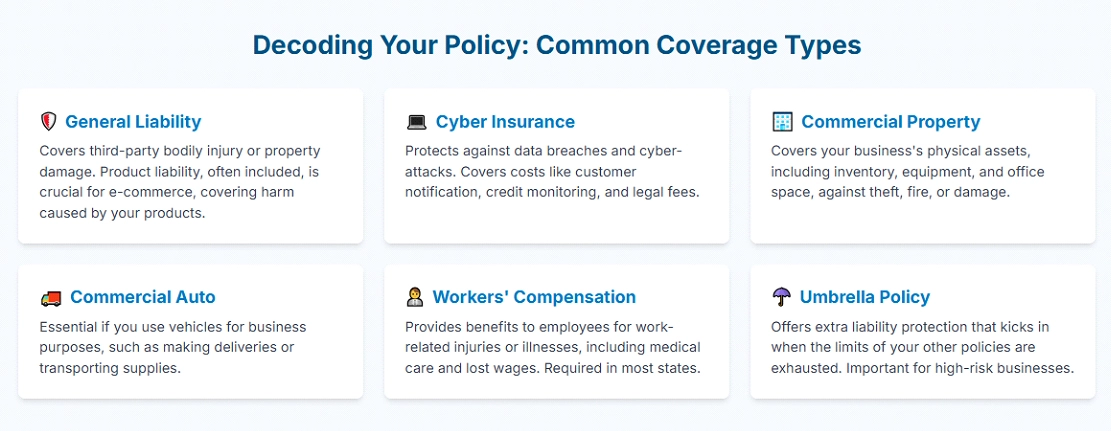
- General Liability Insurance
This is the foundation of any solid insurance plan. It protects your business if you're sued for bodily injury, property damage, or advertising issues.
For example:
- A customer claims your packaging caused an injury.
- Your marketing accidentally infringes on another brand's copyright.
Liability insurance for ecommerce helps cover legal fees, settlements, and medical costs, expenses that could easily reach tens of thousands of dollars. The average cost of GLI Insurance is $42-$85/month.
- Product Liability Insurance
If your products can cause harm, even unintentionally, you need to have this insurance. In ecommerce business insurance, product insurance for small businesses covers lawsuits related to defective, dangerous, or mislabeled products. Whether you're selling supplements, electronics, candles, or toys, a single product issue can result in serious financial consequences. Even if a manufacturer is technically responsible, you, as the seller, are still liable in most marketplaces. The average cost for PLI is $68- month or $810 a year; it can increase if the products are high risk.
- Cyber Liability Insurance
When you sell online, you handle a sensitive part of the customer data, which includes their credit cards, addresses, and passwords, which means e-commerce businesses are a prime target for cyber criminals. With the rise of AI in ecommerce, many tasks are automated and efficient, which opens up new vectors for cyber threats that businesses must address. Cyberattacks can infiltrate your systems through malware, phishing links, or compromised plugins, and in some cases, business laptops that have customer data are stolen or lost. A single breach can damage your finances and your brand reputation.
The threat continues to grow. While in 2024 the FBI reported 859,000 cybercrime complaints, experts estimate there will be $10.5 trillion worth of cybercrime by 2025. Statistics show that at least 61% of small businesses have been victims of cybercrime. In addition, 43% of all reported cyberattacks target small businesses. This shows that smaller business sellers suffer much more than large corporations. The following items are included in cyber liability insurance: Legal and investigative expenditures. Notifications and credit monitoring for customers. Fines for noncompliance for breaches of data.
- Commercial Property and Inventory Insurance
In addition to having a digital store when selling online, businesses have physical assets to manage, such as laptops, photography gear, packaging materials, and inventory. Insurance for online retailers covers the following: Property and inventory (such as stock that remains in your warehouse, fulfillment center, or home), Business operational tools and equipment. Business owners are eligible for recovery of storage and business operation loss due to incidents such as a flood, fire, or theft under the structured insurance policy. Price determination takes into consideration geographic location and region, type of industry, and property worth.
- Business Interruption Insurance
Business Interruption Insurance is essential because there are external circumstances like fire, floods, power outages, supplier shutdowns, or shipping disruptions that no one can control, and any of these events can temporarily halt your online store or fulfillment operations. This type of insurance will cover your income and allow you to stay financially afloat as your business adapts and recovers, ensuring you do not lose both your inventory and your income at the same time. This is especially crucial for sellers who utilize Amazon FBA, Walmart Fulfillment Services (WFS), or third-party logistics centers, as these facilities manage the physical aspects of online retail. Any disruptions on their end will impact your online store.
For small businesses, the average cost of this type of insurance is between $450 and $1560 every year. Insurance providers will determine a more accurate estimate based on factors such as the size of the business, revenue, and the operational area's risks. BII covers: lost revenue by replacing the income you would have earned during the period of shutdown. Covers rent, employee salaries, loan payments, and utilities while your business is non-operational. If you need to move operations (for example, to a new warehouse or workspace) to continue fulfilling orders. Gives extra operating expenses, such as expedited shipping, new equipment rentals, or other costs incurred to resume business quickly. If there is a fire in your third-party owned warehouse, or a major storm disrupts your shipping routes, this kind of insurance helps you ensure your staff get paid, your marketing efforts continue, and your business endures the challenges until the situation normalizes.
- Professional Liability Insurance
If you provide digital services or design templates or deliver business consulting, in addition to selling products, this insurance protects you against allegations of professional negligence. Take the case, for instance, where a customer claims your marketing service adversely impacted their business and caused a profit loss. This insurance would pay for jury trial costs and any out of court settlement fees.
- Workers' Compensation Insurance
Workers' Compensation Insurance is important to protect your employees and your business, no matter the type of employment your business offers. In many jurisdictions, it is a legal requirement to obtain this insurance as soon as you hire your first employee. Risks of workplace injuries exist in online businesses as employees handle packaging, inventory, and deliveries. In addition to workplace injuries, remote employees may develop repetitive strain injuries or ergonomic disorders. In the absence of Workers' Compensation insurance, the employer would hold the legal liability for unpaid medical bills, which would escalate in the absence of coverage. In the case of a workplace injury or fall, this insurance will protect the employees and the employer.
Small businesses can expect to pay $45 to $100 per month per employee. This is based on the type of job, geographical area, and size of the payroll. The insurance pays for medical expenses for hospital visits, rehabilitation, and any future medical treatment for injuries and illnesses sustained through work. It pays for part of the salary of an employee who is unable to work and is recovering. It also pays for post-injury rehabilitation support if the employee is partially or permanently disabled. It pays for death benefits to the employee's dependents if a work-related accident results in death. It pays for any legal defense and settlement in the event of an employee lawsuit.
- Business Owner's Policy (BOP)
It can be confusing and costly for online sellers to manage multiple insurance policies separately. Thus, ecommerce business insurance has a Business Owner's Policy (BOP), which is a convenient package that combines all the essential coverages for e-commerce businesses into one affordable plan. This policy is designed for small to medium-sized businesses, including online retailers, Amazon FBA sellers, and Shopify store owners. It simplifies protection by bundling three core types of coverage that protect your business from physical and financial risks. A standard BOP includes: General Liability Insurance, Commercial Property Insurance, and Business Interruption Insurance.
Certain insurers provide modular options for Business Owner's Policies (BOPs). This might include add-ons such as Cyber Liability Insurance (protection for your data on the internet). Product Liability Insurance and Professional Liability Insurance (which covers service-oriented businesses). For instance, a business operating on Amazon or Shopify could utilize a BOP to ensure inventory, marketing materials, and customer claims made under the policy. Should your stock be damaged by a warehouse fire, or if an event covered by your policy renders your website inoperative for a period, your BOP will restore your operational capacity and recoup your lost profits.
Best Ecommerce Business Insurance
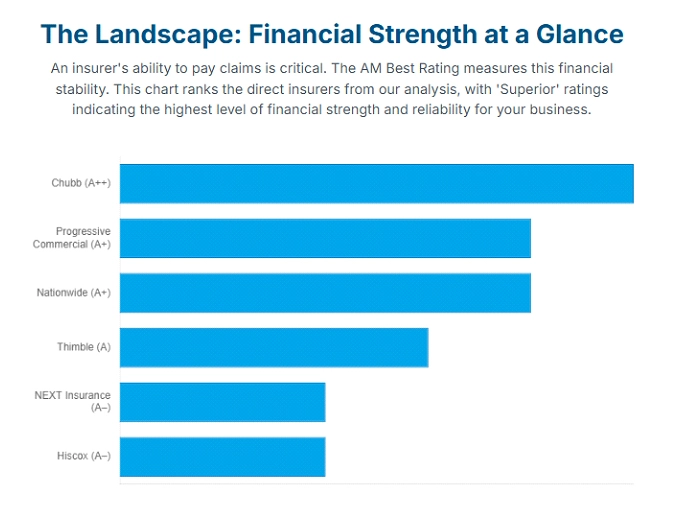
| Name | Best For | Price | AM Best Rating |
|---|---|---|---|
| NEXT Insurance | Amazon and online marketplace sellers | From $19/month | A- (Excellent) |
| Hiscox | Small businesses need flexible, customizable plans | From $30/month | A- (Excellent) |
| Thimble | Short-term or project-based ecommerce sellers | Varies by duration and business type | A (Excellent) |
| Insureon | Comparing multiple insurer quotes in one place | Varies (depends on partner insurer) | (Varies by partner) |
| Simply Business | Fast online quotes for small ecommerce businesses | Varies by partner insurer | (Varies by carrier) |
| Progressive Commercial | Ecommerce stores managing delivery or fleet vehicles | Request a quote | A+ (Superior) |
| Nationwide | Hybrid (online + offline) retailers | Request a quote | A+ (Superior) |
| Chubb | Large or high-risk ecommerce enterprises | Custom pricing based on risk level | A++ (Superior) |
Best for: Amazon and online marketplace sellers
NEXT Insurance is a digital-first provider built for small ecommerce sellers. It is best suited for Amazon and Etsy sellers who need to meet marketplace insurance requirements. NEXT's offers quick online setup and transparent pricing, which makes it ideal for small and mid-sized sellers.
Coverage includes:
- General liability (with product liability).
- Commercial property and auto.
- Workers' compensation.
- Cyber/data breach coverage.
- Multi-line bundled protection.
Best for: Small businesses needing flexible, customizable plans
Hiscox offers policies that are designed for small ecommerce operations with the option to combine multiple coverages under one Business Owner's Policy (BOP). This company is known for its flexibility, as it allows e-commerce sellers to scale coverage as their business grows.
Coverage includes:
- General liability.
- Professional liability (E&O).
- Cyber insurance.
- Property protection.
- Workers' compensation.
Best for: Short-term or project-based ecommerce sellers.
Thimble provides on-demand insurance, which is perfect for sellers who participate in pop-ups, craft fairs, or seasonal events. You can get instant proof of insurance through their app.
Coverage includes:
- Short-term general liability.
- Short-term professional liability (E&O).
- Temporary coverage by the hour, day, or month.
Best for: Comparing multiple insurer quotes in one place
Insureon is an aggregator platform that lets e-commerce business owners compare policies from multiple top-rated insurers at once. Insureon doesn't underwrite policies itself but simplifies finding the best quote for your business.
Coverage includes:
- General and professional liability.
- Property insurance.
- Cyber insurance.
- Auto (depending on carrier).
Best for: Fast online quotes for small ecommerce businesses
Simply Business acts as a digital broker that connects e-commerce entrepreneurs with multiple insurers for fast coverage. It's a great option for startups that want multiple quotes within minutes.
Coverage includes:
- General liability.
- Property protection.
- Cyber liability.
- Workers' compensation.
Best for: E-commerce stores managing delivery or fleet vehicles
Progressive Commercial Insurance is a well-known name for businesses that operate vehicles or delivery fleets alongside their online store. Their competitive rates and strong claims service make them ideal for logistics-heavy sellers.
Coverage includes:
- Commercial auto insurance.
- General liability.
- Property coverage.
- Optional cyber insurance.
Best for: Hybrid online and offline retailers
Nationwide provides customizable coverage for omnichannel retailers with ecommerce and brick-and-mortar operations. It's a strong choice for scaling ecommerce brands.
Coverage includes:
- General and product liability.
- Business property and equipment protection.
- Cyber and speciality coverages.
- Umbrella policies.
Best for: Large or high-risk ecommerce enterprises
Chubb specializes in high-limit, global, and speciality insurance for larger e-commerce brands selling high-risk products. It's best for established e-commerce brands with complex or international operations.
Coverage includes:
- Global coverage.
- Product recall protection.
- Catastrophic and supply chain risk coverage.
- High-limit liability options.
How to Get Ecommerce Business Insurance
Whether you're selling digital goods or physical products, the right e-commerce business insurance policy will act as a financial shield against unpredictable events. As every online business has different risks, coverage needs, and sales channels, you need to get personalized quotes, through which you pay for what you need.
Here's how to evaluate:
Before requesting quotes, evaluate which type of insurance your business needs. Most e-commerce sellers start with general liability, product liability, and cyber liability insurance. If you store inventory and have a warehouse, you need to have property or business interruption coverage. Understanding the specific risks you face will help you select the best insurance for online sellers to protect your operations and assets.
Insurance providers will ask for your:
- Legal business name (LLC) and business structure (sole proprietorship, etc.).
- Annual revenue and expected growth.
- Type of products you sell and what is the sourcing method (manufactured, dropshipped, resold).
- Number of employees and fulfillment locations.
- Platforms you use for selling, like Amazon, eBay, Shopify, Walmart, etc.
Once you request quotes from several providers, use online comparison tools like Next Insurance, Hiscox, Simply Business, or The Hartford to compare the prices.
A standard insurance plan doesn't cover everything, so if you operate your business in international markets and have different sales channels, request to get customized quotes by letting them know about your business operations, like shipping across borders, getting international returns, or digital product sales.
Review the quotes given by them for coverage limits, deductibles, and exclusions. For example, check whether the policy covers third-party platforms' requirements (like Amazon's $1 million liability rule) and online fraud protection.
If you're not sure about which insurance type will fit best for your business, get a consultation from an agent. They will help you structure your ecommerce business insurance based on your risk profile and platform requirements. They will make you understand quotes, explain hidden clauses, and ensure you're not under- or over-insured.
Insurance Claims Process of Ecommerce Businesses
Here's how you can claim insurance if any incident happens.
When an incident such as a cyberattack, product damage, shipment loss, or customer injury happens, collect the details like date, time, photos, receipts, and relevant information (like customer complaints or police reports) and inform your insurance provider immediately, as some insurers have strict deadlines for filing claims. Here's what to do:
- When it happens, call your insurance company quickly.
- Tell them when it happened, who was involved, and when it occurred.
- Follow their instructions.
- Provide all the documents.
Your insurer will ask for your documents to calculate the damage and loss. The documents include:
- For damaged goods or property, you'll need proof of purchase and ownership.
- Invoices and shipping records will be needed for lost shipments.
- Customer correspondence and legal notices if you get a liability claim.
- Cyber logs or IT reports for data breach claims.
After doing the review, the insurer will determine if the claim is approved they will then calculate your payout based on:
- Your deductible amount.
- Coverage limits.
- Proof of loss and supporting evidence.
Timelines:
- Minor property or shipment claims take 1-2 weeks. Having an organised ecommerce business insurance makes the process quick when incidents occur.
- Cyber or product liability claims: 3-6 weeks (depending on investigation complexity).
Let Spectrum BPO Handle Your Daily E-commerce Operations
Insurance for an e-commerce business is important to protect your online business from unforeseen risks, but the main part is managing your e-commerce operations, which keeps your business running smoothly. In our Full Ecommerce Services, we manage the day-to-day account operations on platforms like Amazon, Walmart, eBay, and Etsy. For an online store, you need to stay on top of everything, like orders, inventory, advertising, listing optimization, account health, and platform rules. That's the hard part, and it's where most sellers get stuck. We take care of your backend tasks. With the support of SpectrumBPO, you can focus on growing your brand, launching new products, and improving your customer experience, while we handle the operational complexity behind the scenes.
FAQs
E-commerce insurance costs:
- General Liability: $42-$85/month.
- Product Liability: ~$68/month or $810/year.
- Cyber Liability: Varies by coverage.
- Business Interruption: $450-$1,560/year.
- Workers' Comp: $45-$100/month per employee.
- Bundled plans (like a BOP) can start from $19/month.
Your needs depend on what you sell, how you operate, and where you sell. The types of ecommerce business insurance include:
- General Liability for injury or damage claims.
- Product Liability for defective products.
- Cyber Liability for data breaches.
- Property Insurance for inventory and equipment.
- Business Interruption for lost income during downtime.
- Workers' Compensation if you have employees.
- BOP (Business Owner's Policy): bundles essential coverages.
Share this Post




Blog Categories
Uncategorized
