
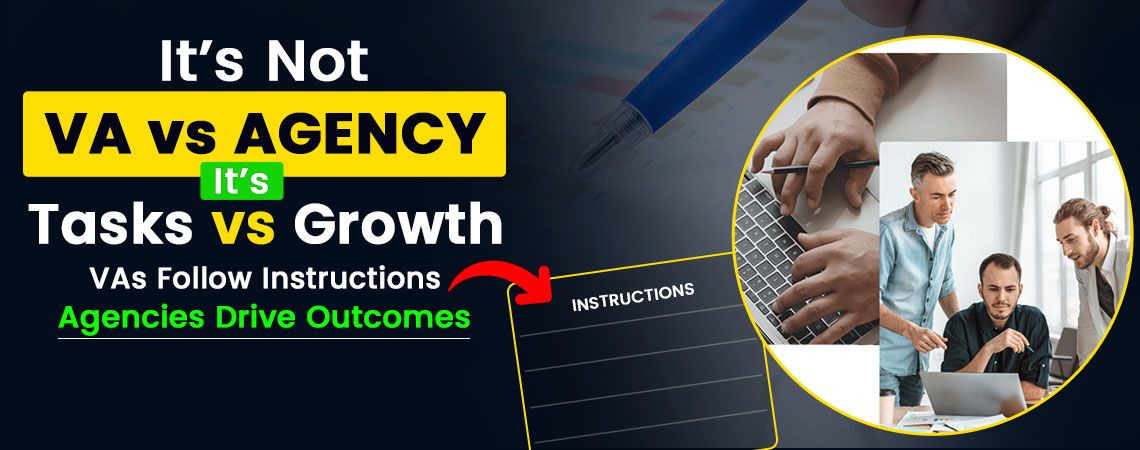
Difference between a virtual assistant and an ecommerce growth agency
Comparing a Virtual Assistant to an agency isn't about a price comparison, it's about what kind of support actually works for your business to grow. A virtual assistant does what you tell them to do, but an ecommerce growth agency works to create a strategy, offers its professional experience, and takes ownership for your results. When it comes to sustainable growth, you need to consider whether you need strategic planning, specific expertise, accountability for results, scalability, or long-term business growth. The decision on who to work with should not be about who costs less but about who can deliver the growth your business deserves.
This question comes up a lot in discussions with sellers:
"Should I bring a virtual assistant on, or should I work with a group like yours?"
And every time, we answer:
"What are you trying to do, and how quickly do you want to get there?"
Most of the time, there's silence. They are weighing this as a cost analysis, not as a growth decision.
And that's the real issue.
A VA versus an agency, compared on cost is equivalent to a compare a part-time helper to a full complement growth team. It is not about cost, it is about fit, function, and focus.
 Michael's Story: The Plateau That Changed Everything
We met Michael, when his outdoor equipment provider hit the wall.
For three years, his Amazon storefront earned $35,000 each month. Consistent. Predictable. He had two VAs managing day-to-day communications, inventory, customer messages, basic Amazon product listing optimization services, and updates.
It was working. But it wasn't moving.
"They do everything I ask them to do. But, we're not growing. I have the same revenue I did a year ago."
What Michael really needed wasn't more help; he needed the right kind of help.
The Real Differences Between VA and Agency
We've witnessed this scenario many times before. A business owner hires a VA to offload some tasks, and it helps. But at some point, the business will stop developing because the support is fundamentally built around task execution rather than task planning and general business development.
VAs are employed to follow instructions; that's the whole idea.
But if nobody is accountable for planning the correct tasks, while also physically analyzing why growth has halted, nothing changes. We have seen sellers assign more tasks, they have longer SOPs, and they even add more VAs.
Still no change.
"This isn't about the volume of work completed, it's about getting the right work done that produces results."
VAs generally have a good understanding of all aspects of Amazon operations, sufficient to manage listings, respond to customer emails or update a A+ content.
But they are not capable of analyzing PPC data, analyzing best performing copy or content for A/B testing, marketer eyes for Amazon A+ design or repositioning the brand effectively in a competitive product category.
When Michael's account was reviewed, the product pages looked clean and it had stable inventory. But his listings were not converting, ads were poorly optimized, and his brand image was not visible at all.
It was not a task issue, it was a performance issue, so he had to layout a detailed plan for all staff, just to get started.
VAs are assessed according to how you performed your tasks. If you had a drop in revenue, you are not responsible for the outcome, as you did what you were asked.
Agency structures are focused on outcomes. If the desired outcomes were $75K per month and the account is stuck at $40K, then something isn't working, and it is our responsibility to figure out what went wrong.
That is not an expectation. That is the basis from which the relationship begins.
Michael shared something we hear often, "When Amazon changes something, I have to figure out what I am supposed to do. Then I have to explain it to my VAs."
That is not a support system. That is delegating and offloading work (with homework).
When you have a team in place and a platform change arises, there is no "figure out the new plan" step. The new plan is created and executed, right away. There is no "waiting for the instructions".
This is the essential distinction between managing tasks and managing growth.
Michael's business operation determined that he needed someone for Amazon PPC management, someone for design and someone for copy. For each new role, there is a new hire. More onboarding, more coordination.
When the need is multi-dimensional, Ads, Content, Data, Design, you wind up with inefficient internal build-out.
In this scenario, the Agency structure wins over the VA model. The specialists are already in place. You don't need to hire additional people, no duplication or coordination gaps to deal with.
Just movement.
Michael's Investment Shift
He was paying $1,200/month for support from VAs.
His agency partnership was $2,800/month.
It was not an increase in payment. It was a shift in what the investment was accomplishing, it was for the first time, actually moving the needle.
90 Days Later: Measurable Changes
| Metric | VA Results | Agency Results |
|---|---|---|
| Monthly Revenue | $35,000 | $58,000 |
| New Products Launched | 0 | 2 |
| PPC ACOS | 45% | 28% |
| Hours Saved Weekly | 0 | 15 |
| Top Keyword Rankings | 0 | 3 (Top 3 position) |
It was not more people doing more stuff. It was the right team solving the right problems.
In Michael's words, "My VAs helped me work in the business. My Amazon brand consulting helped me grow the business."
This isn't about one being objectively better, it's about choosing one based on the actual need you are dealing with.
Lisa, one of our closest friends, had a product line turning $15K/month. She had her strategy, direction and vision. She just needed someone to help keep the wheels in motion of orders, messages, listings.
That's when VA support is appropriate. The direction is already clear.
David, now a profitable seller, had a store turning $40K/month, but it hadn't grown in a year. He couldn't put his finger on why. His team was busy, but the results were flat.
He requested an audit of his business, refocused the brand, launched three new campaigns and made progress on redefining the product content across listings.
Five months later, David's business exceeded $75K/month.
That kind of movement doesn't happen just by "doing more and working harder."
Sarah, another friend, used both VA and agency support. VAs managed day-to-day workflow, while her agency managed strategy, campaigns and product rollouts.
Everyone had clear boundaries and there was no overlap in execution and the business grew independently of any individual's capacity.
The business scaled faster than it had in two years.
Common Mistakes We've Observed
- Hiring more VAs, anticipating growth
Although there is more capacity, it does not create a strategy. - Using an agency for administrative work
When high-level support is misapplied, it creates waste, not win. - There is no defined line between roles
In that situation, confusion grows faster than revenue.
Investment Framework
| Support Model | Typical Investment | Best Use Case |
|---|---|---|
| VA only | $800-$2,000/month | Execution, operations, admin |
| Agency only | $2,000-$8,000/month | Growth, strategy, expansion |
| Hybrid | $1,500-$4,000/month | Efficiency + strategic advancement |
What is the cost? By picking a bad structure, you will be stuck for another six to twelve months.
What Should be Your Decision Framework
This is not a binary choice for us.
- When tasks are clearly defined and direction is set, the VA model works
- When growth stagnates without obvious reasons, the Agency model addresses deeper problems
- When you need both, build a system that separates daily execution from strategic advancement
This is not about guessing what will work. It is about realizing where the real need exists and structuring support around that.
Consider Strengths and Weaknesses of VA and Agency
Every seller eventually reaches this crossroads. It is not about who is cheaper or who puts in more hours. It is about who is going to move the business forward. When you consider that, the decision becomes much clearer. And, when the goal is growth, clarity always precedes scale.
If you are an existing seller, you certainly know your brand inside and out and hiring a VA may be a cost effective means of delegating those mundane tasks. When you are a new seller, standing at the edge of your Amazon dream, you need more than task support. You need strategic ideas and insights. This is the strength of an ecommerce agency. An expert team for affordable eCommerce startup services doesn't just implement, they identify and expose opportunities and threats you didn't even know existed. The kind of insight that makes you stop in your tracks and say, "I would have never thought of that." To a new seller, this makes all the difference in the world.
Share this Post




Blog Categories
Uncategorized
