
AI in ecommerce
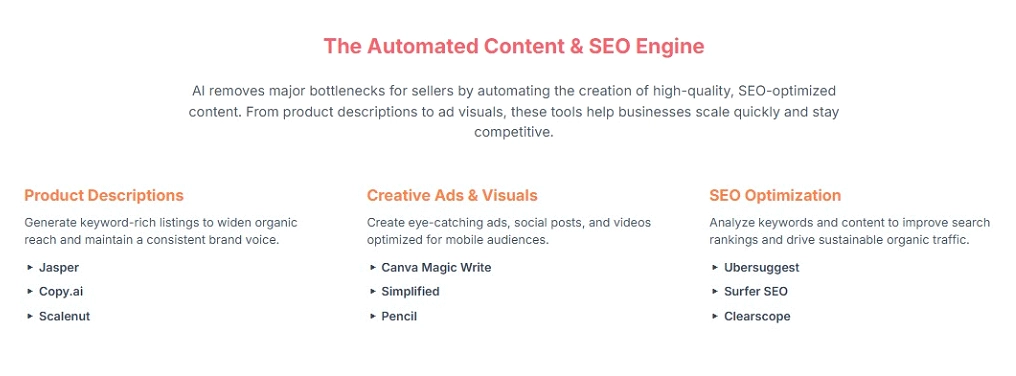
AI is reshaping how sellers grow their online stores across all types of e-commerce, like B2C, B2B, C2C and C2B. It recognizes customer preferences, personalizes recommendations and manages ads and automates main operations like inventory and marketing. Sellers are using platforms depending on their needs and the outcome they want, like Jasper.ai, Copy.ai, and Scalenut, for writing descriptions, titles, and tags with rich keywords. Tools like Canva Magic Write, Simplified, and Pencil are helping them to generate professional visuals. For optimizing email marketing and giving personalization to make new visitors into repeat buyers, they are using Mailchimp, Klaviyo, and Brevo. To boost visibility and gain organic traffic, they are using tools such as Ubersuggest, Surfer SEO, and Clearscope. Instead of replacing human creativity, it works alongside sellers to help them save time, reduce errors, and focus on strategies that drive growth.
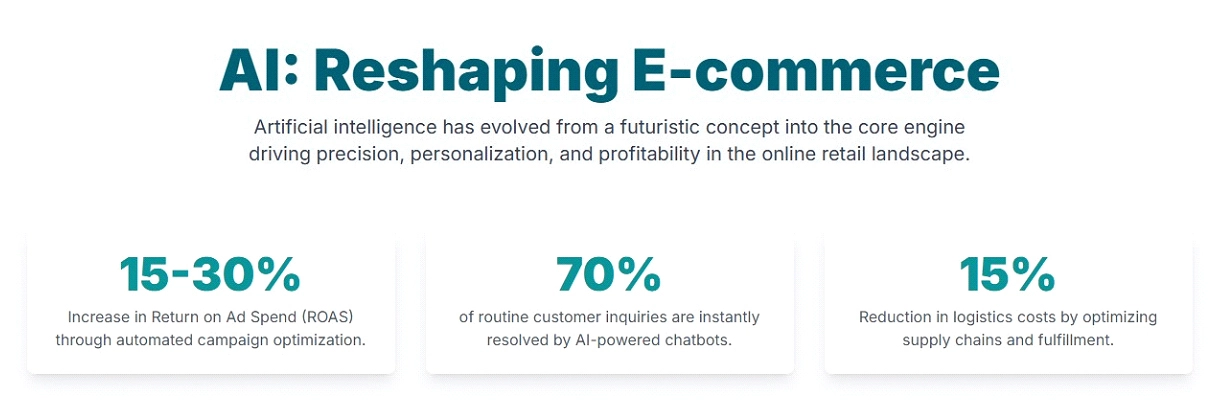
Artificial Intelligence (AI) is not only a catchword in e-commerce, it's an engine driving results. AI is changing how online businesses operate and how customers shop, from inventory management to product recommendations. AI in ecommerce is getting effective. It allows e-commerce brands to deliver relevant and engaging shopping experiences by understanding customer behavior, anticipating trends, and automating tasks that once required human effort. It doesn't matter if you have a small online store or a global marketplace; integrating AI in your business can help you boost sales, improve customer satisfaction, and streamline operations, giving your team more time to focus on strategy and creativity.
 In What Ways AI Is Changing the Game in e-commerce
- Artificial intelligence ecommerce tools are helping businesses to grow more smartly, no matter if they've a small online store or are established sellers.
- AI recognises what your customers want, sometimes even before they do. It affects product recommendations, voice searches, and even support in different languages to make online shopping feel easy for buyers.
- With tools like Jasper, Copy.ai, and Canva Magic Write, you can write product descriptions, emails that look professional and match the seller's brand style without hiring a copywriter or designer.
- Platforms powered by AI, like Pencil and Simplified, let you design attractive ads and videos. By which your marketing can look impressive, even on a low budget.
- Mailchimp, Klaviyo, and Brevo make your email with timing, personalization, and segmentation that help turn subscribers into loyal customers.
- Tools like Ubersuggest, Surfer SEO, Helium 10, JungleScout, Viral Launch, Keepa, and Clearscope help you find the right keywords and enhance your content so you can get traffic organically.
- AI-powered forecasting helps sellers avoid stockouts and overstocks. It tracks trends, predicts demand, and keeps warehouse costs low, especially important for Amazon FBA sellers. Platforms like Fintechzoom give light to Amazon E-commerce Stocks, helping investors and sellers stay updated on financial trends and stock performance in the AI-driven retail landscape.
- Even buyers who buy in bulk expect quick, personalized experiences. AI handles bulk orders, custom pricing, and estimates restocking, making artificial intelligence ecommerce effective for B2B and B2C.
- AI-made ad management (like Amazon PPC) improves ROI by constantly testing and optimizing campaigns, so you no longer waste money on ads.
- With AI insights, sellers can track reviews, update listings, and make sure their brand looks refined and trustworthy on every platform, especially in competitive platforms like Amazon.
AI Technologies in E-commerce
It is an advanced form of machine learning that copies how the human brain processes information. It's best at studying huge, complex data sets, which make sense of unstructured data like images or natural speech.
Deep Learning as AI in ecommerce is used for:
- Image-Based Product Matching: AI in ecommerce uses visual recognition to find and recommend products that look similar to what a customer is viewing.
If someone clicks on a leather handbag, the platform will instantly show other bags with a similar style, color, and size, making it easier to find the perfect match.
- Voice-Enabled Shopping: This allows customers to search and shop by using voice commands, giving them a faster and more accessible experience.
A customer says, Find a gift for a 10-year-old girl under $30, and the AI ecommerce assistant directly suggests toys and books within the budget according to the age.
- Auto-Tagging Product Listings: This AI based ecommerce platform will scan product images and descriptions to generate accurate tags and categories.
When a seller uploads a photo of a floral maxi dress, the AI automatically tags it with keywords like "women's fashion," "summer dress," "floral print," and "boho style," making it easier for customers to discover it through search and filters and making it wider for the audience to reach this.
Machine Learning enables systems to get an idea from customer behavior and improve over time, without being programmed for every scenario, making it a key part of AI in commerce. In e-commerce, this powers many behind-the-scenes decisions that make shopping feel smooth and smart. ML helps e-commerce platforms to optimize their performance, from marketing to logistics, often without anyone realizing it.
Real-world ML use cases include:
- Smart Coupon Targeting: Where discounts are automatically offered to buyers most likely to convert.
- Return-Risk Prediction: flagging purchases more likely to be sent back based on previous customer behavior.
- Automated Email Timing: where follow-up emails are sent at the time customers are most likely to open them.
This technology helps machines to understand and process like human language. NLP boosts product discovery by making searches smarter. This helps remove search experience and makes online shopping feel natural, like speaking to a store assistant.
The NLP features are:
- Finding What Buyers Want: It allows AI to understand what buyers want, not what they type. It makes search results relevant and personalized by focusing on goals instead of keywords.
When a buyer searches for "something warm for a hike," it shows thermal jackets and hiking boots, not basic outdoor equipment.
- Relevant Recommendations: Context-aware suggestions consider a shopper's behavior, preferences, and recent activities to recommend useful products. This makes the shopping experience smoother for buyers.
If someone added a foundation to their cart, the site suggests translucent powder, blender, or brushes, because it knows what the shopper needs with these products.
- Supports Many Languages: This breaks down language barriers by responding to consumers in their native languages. It helps brands connect with global audiences and give a broader customer experience.
If a Spanish-speaking client searches for "zapatillas deportivas", they will see the same athletic shoe options as someone searching in English for "running shoes."
Recommendation engines are the "you might also like" of an e-commerce site. They use AI in ecommerce to monitor products that match a shopper's tastes, increasing cart size and customer loyalty.
Types of recommendations you'll see powered by artificial intelligence in e commerce:
- In "Style match" suggestions, it offers items in the buyers' aesthetic (e.g., minimalist home décor).
- "Bundle builder", which suggests complementary items to make complete outfits or kits.
- Real-time trending suggestions, which update based on what's popular in a shopper's location or demographic.
- These algorithms turn static catalogues into experiences, giving customers reasons to buy and retailers chances to sell more.
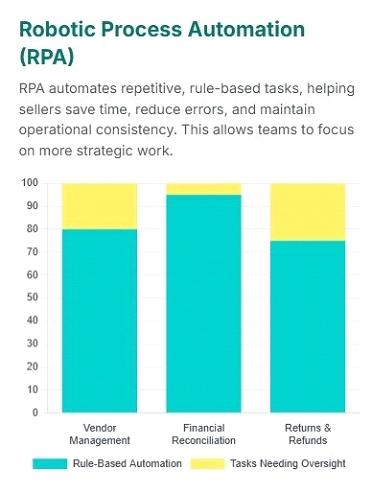
This is a software that helps in the automation of tasks based on rules. It helps sellers save time, reduce errors, and maintain consistency in operations. It plays a crucial role in AI in commerce by helping sellers maintain consistency in operations.
The following are RPA elements that can be used as AI in ecommerce:
- It helps in vendor onboarding, supplier data, verifying documents, and product listings.
- Match payment records with shipped items and highlight any errors.
- Managing returns and refunds by approving requests based on policy rules.
- It takes care of the important tasks so the team can focus on the strategic side.
Generative AI, also known as GenAI, uses large language models (LLMs) and other deep learning techniques to create new content like text, images, video, or code. In e-commerce, GenAI is becoming a powerhouse behind content production and personalized experiences.
GenAI applications in e-commerce include:
- Auto-generating banner copy and marketing emails based on the customer's browsing behavior.
- Creating product images from text descriptions that are useful for previewing custom items (e.g., personalized mugs or t-shirts).
- Making FAQs sessions and help centre content that's based on customer questions.
For retailers, GenAI means saving time while scaling up creative assets without losing personalization. Amazon has also evolved its shopping experience with Alexa replaces Rufus as Amazon's AI Shopping Assistant, alongside tools like Rufus AI, Metis chatbots, and targeted promotions that combine NLP and automation to improve listings, customer support, and ad performance.
Technologies like Rufus AI, Metis Chatbots, and Targeted Promotions on Amazon combine NLP and automation to help sellers improve their listings, handle customer queries, and create better ad campaigns.
AI In B2B
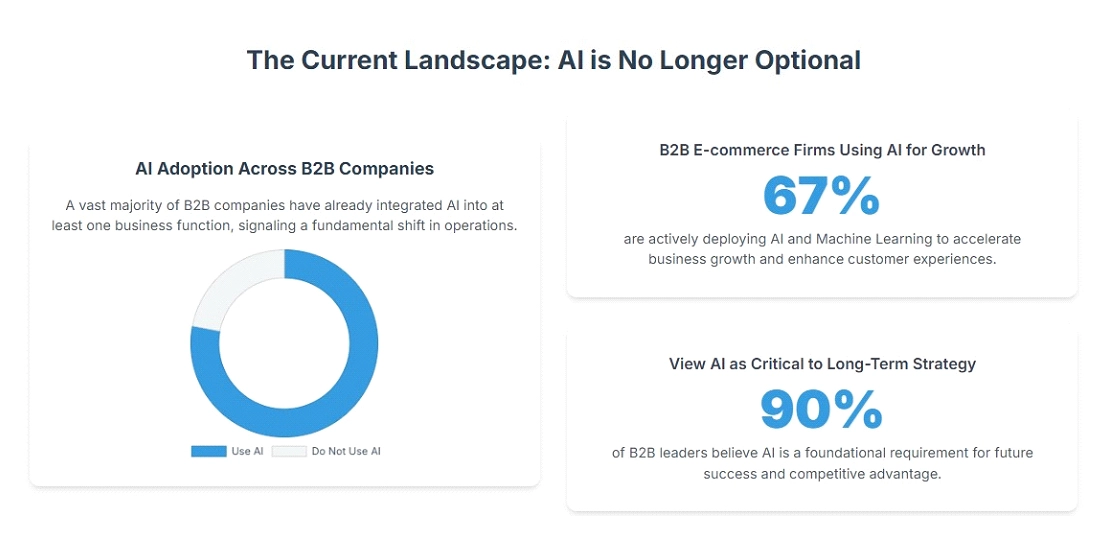
As B2C (like Amazon or Walmart), customers get fast and effortless shopping. Now, buyers in B2B want to get the same experience. They don't want to go through templates or have follow-ups from sales representatives to get the prices. They want speed and smooth transactions, and that's where artificial intelligence in B2B e-commerce is helping businesses. AI helps in repetitive tasks, personalised buying experiences, predicts demand, and highlights issues before they happen. According to B2B ecommerce statistics, many B2B companies are exploring and implementing AI in ecommerce.
Example: Let's say if a person is managing procurement for a chain of hotels; they don't want to reorder towels manually every month. AI understands, the system learns your usage, predicts when stock will run low, and reorders.
If you're wondering how to use AI in ecommerce in B2B, here's what's working:
- Pricing engines that are AI-driven adapt in real-time based on market demand, competitor moves, or buyer history.
- Chatbots that answer FAQs and product queries.
- Understands business terms like "bulk order" and shows accurate/relevant products.
When I was helping manage digital transformation for a B2B industrial supplier, we struggled with buyers calling to ask about stock availability and pricing. Once we implemented an AI-powered chatbot and real-time inventory visibility, calls dropped by 60% in the first three months. Our sales team finally had time to focus on strategic accounts instead of answering the same questions again and again. It was like an Affordable ecommerce growth for us. That's when I saw how artificial intelligence in B2B ecommerce is a time-saver.
Benefits of Using AI in ecommerce
When you insert an AI system, you stop guessing what the problem is in your business. When I launched my very first online store, the budget was tight, and I didn't have the extra amount for hiring writers, designers, or marketing pros. I decided to explore what free AI and ecommerce strategies are and what they could do.
Here's what AI e-commerce can do for your business:
AI in ecommerce allows your store to predict what customers want before they even know it themselves. It goes into their recommendations, landing pages, and email flows.
Personal Experience:
Once I helped a friend revamp her online skincare store, we used AI-driven product recommendations. Customers who usually bought just one item started buying bundles, and the average order value jumped by 28% in 45 days because the site learned what each customer cared about.
- Product Descriptions
AI tools like Jasper, Copy.ai, and Scalenut help sellers to write listings which has SEO keywords, to reach a wider audience.
New sellers can use these tools to set up their platforms with clean listings without hiring a writer. Existing sellers can refresh their outdated listings to match customer expectations or seasonal trends. It keeps tone and formatting consistent, good for brands that are trying to scale.
- Jasper is an AI tool that helps e-commerce sellers make high-quality marketing content and write product descriptions. This offers customizable tone and writing capabilities, making it ideal for creating content.
- Copy.ai This offers quick and creative solutions to write product listings, ad copy, and social media posts. It's user-friendly and efficient, perfect for e-commerce sellers who want engaging content without spending hours and hiring anyone.
- Scalenut Scalenut is an all-in-one, that focuses on SEO and content marketing. It helps businesses plan, research, and optimize content to improve search rankings and get more organic traffic to their online stores.
When I first listed my products, writing descriptions for 30 items, it felt overwhelming. I turned to Copy.ai's free plan. I used to input the product type and features, and it would give me a bunch of variations in seconds.
The biggest challenge was getting the content to sound like "me." Some descriptions felt too robotic, especially for lifestyle products. To fix that, I made instructions and fed them into the tool every time I started a new batch. I gave the command to "Use a friendly, helpful tone with lively adjectives," which made a big difference. I also grouped similar products and got myself into Amazon SEO services so that this could maintain consistent language across each category. Once I got into the flow, I was generating 15--20 descriptions a day without burning out and compromising on quality.
- Creative Ads & Visuals
Tools like Canva Magic Write, Simplified, and Pencil help sellers to make attractive ads, social media posts, and promotional videos that are eye-catching for people scrolling through their phones.
New sellers can build brand awareness by using AI in ecommerce, and existing sellers can keep their campaigns relevant by updating their visuals to match trends.
- Canva Magic Write: This is an AI-powered writing tool that is built into Canva that helps sellers in generating headlines, writing captions, and content in short form to go with their visuals. It's great for putting together ad creatives, social media posts, or promotional banners with text and design in one place.
- Simplified: This AI platform is for creating videos, ad creatives, and social content. It's useful for e-commerce users who want to design engaging visuals, write copy, and schedule posts from one dashboard, which doesn't require any design skills.
- Pencil: It uses AI to generate and test data-backed video ads optimized for performance. It's best for e-commerce brands running paid campaigns, helping them create ad variations faster and improving ROAS (return on ad spend).
For ads and social posts, I started with Canva's Magic to brainstorm captions and headlines. I used to pair those with Canva's templates to make attractive designs. I also used Simplified to make short product highlight videos.
My visuals lacked consistency and looked too "template-y," so I planned to get graphic design services for Amazon. They made all my visuals look more cohesive, though they were built using free tools.
- SEO Optimization
Software like Ubersuggest, Surfer SEO, and Clearscope analyzes keywords and content to help sellers improve their search rankings and get organic traffic. New sellers can use these to make rich SEO, product pages from the start, and experienced sellers can optimize their existing content to stay competitive in search results.
- Ubersuggest is an SEO system that helps sellers find keywords, analyze their competitors, and optimize content to boost visibility. It's perfect for new sellers who want to have organic traffic.
- Surfer SEO: This offers content optimization by analyzing ranking pages and suggesting improvements. E-commerce sellers can use this to make their product descriptions for higher search engine rankings.
- Clearscope: This is to improve content and SEO performance through targeted keyword suggestions. It's best for scaling sellers who want to post highly optimized content.
For keyword research, I tried using UberSuggest's free features to find keywords that were related to my niche. I tried Surfer SEO's free trial to optimize product care tips to mention in the description, and it helped me get organic traffic.
It was difficult to apply the SEO data to my content. I watched a few tutorials on Ubersuggest and followed Surfer's on-page checklist. I didn't understand everything quickly, but using their recommendations improved my content ranking.
- Email Marketing
Platforms like Mailchimp, Brevo (Sendinblue), and Klaviyo use AI to automate email campaigns, personalize messages, and adjust send times to get a good reach.
New sellers can benefit from simple setups that help them bring in customers, and established sellers can benefit by boosting their repeat purchases.
- Mailchimp: Mailchimp is a platform that is made for campaigns, personalizing messages, and adjusting send times. It's best for sellers who want to manage customer relationships without hiring someone for 24/7.
- Brevo (Sendinblue): This gives email and SMS marketing, which includes automation and delivery optimization. It's great for sellers who want to communicate with their customers without paying high costs when they are new.
- Klaviyo: It is a system built for email and SMS marketing. It is linked with platforms like Shopify and WooCommerce, using customer behavior data to send personalized messages that can help boost sales.
It's best at logistics. It can track buying behavior, seasonality, and regional demand to forecast stock levels, which results in less overstock, fewer out-of-stocks, and a good bottom line. This is where AI in retail commerce saves money on the backend.
New sellers struggle with overordering due to stockouts. With AI-powered demand forecasting, you can order smart, not more, if you use fulfillment centers like Amazon FBA. Experienced sellers can improve seasonal planning, avoid costly storage fees, and know when to restock based on real patterns.
Personal Experience:
Last year, I helped a friend who sells kitchenware online. Every holiday season, she'd either run out of stock too early or be stuck with unsold items into February. She tried spreadsheets and sticky notes, but nothing worked.
That's when we plugged in an Amazon FBA warehouse management tool with AI-driven demand forecasting. The tools in it analyzed past sales, current trends, and upcoming holidays to predict what she needed to restock and when. She optimized her inventory across all FBA warehouses, kept her storage fees in check, and avoided those stockout warnings that mess with Amazon rankings.
AI e-commerce solutions like this don't just save time, they save money too. When you combine smart forecasting with machine learning and ecommerce, you make decisions supported by real data, not by a rough idea. And when your fulfillment is handled by tools that understand what sells, when, and where, you're not just running a store, you're building a well-oiled machine.
Brand Maintenance with AI
Maintaining a strong brand presence on e-commerce platforms is difficult. Many e-commerce sellers plan to take Amazon brand management services, which help them maintain stability across listings, track reviews and ratings, and ensure compliance with platform policies. With AI-powered insights, sellers can manage status, build their customer trust, and give protection to their competitive edge.
Build Your Growth Strategy with the Right Support
AI in ecommerce is transforming how online stores attract, convert, and keep loyal customers. You don't have to adopt every tool overnight; understanding what's possible with AI helps you stay competitive and make smarter business decisions. Whether you're a new seller facing issues with all the tech options or an established brand looking to grow, our ecommerce agency is here to help you. We help sellers to evolve the landscape, including AI-powered solutions, so you can focus on building a brand that lasts and gives you more profit. Let us help you create a strategy that works for where you are now and where you're headed next.
FAQs
How is AI used in e-commerce businesses?
AI in ecommerce helps companies manage inventories, automate processes, customize purchases, and improve marketing. By using Artificial Intelligence, sellers get chatbots, SEO, email campaigns, ad creation, and demand forecasting, which makes their operations smoother and their business more profitable.
How do I use AI to promote my e-commerce store?
You can use AI tools to write product descriptions, design ads, emails, and SEO content with rich keywords. Platforms like Jasper, Canva, and Klaviyo help automate marketing, personalize messages, and optimize campaigns, so you can get potential traffic, with more conversions and grow your store efficiently.
Share this Post




Blog Categories
Uncategorized
